Reflecting With God 10/13/2022

reflecting with God header
Thinking, praying, reading, studying the Bible – when we do these things, we are reflecting on the Word of God. To reflect is to contemplate and/or consider, and God wants us to deeply reflect on His Word so that we can better understand Him.

Thursday Reflecting

The bin of flour was not used up, nor did the jar of oil run dry. – 1 Kings 17:16.

God never leaves us in His debt. He takes care to pay for His entertainment, royally and divinely. He uses Peter’s fishing smack, and gives it back, nearly submerged by the weight of the fish which He had driven into the nets. He sits down with His friends to a country marriage-feast, and pays for their simple fare by jars brimming with water turned to wine. He uses the five barley loaves, and two small fishes; but He fills the lad with an ample meal. He sends His prophet to lodge with a widow, and provides meal and oil for him and her for many days.
~ F. B. MEYER

reflecting with God footer 2

Unless otherwise noted, Scripture taken from the New King James Version®, NKJV © 1982 by Thomas Nelson.
Used by permission. All rights reserved.
Posted in Reflecting With God | Tagged , , , , , , , , , , , , , , , , , , , , , , , , , , , , , , , , , , , , , , , , , , , , , | Leave a comment

Be Like-Minded With Christ

Therefore if you have any encouragement from being united with Christ, if any comfort from his love, if any common sharing in the Spirit, if any tenderness and compassion, then make my joy complete by being like-minded, having the same love, being one in spirit and of one mind. Do nothing out of selfish ambition or vain conceit. Rather, in humility value others above yourselves, not looking to your own interests but each of you to the interests of the others. In your relationships with one another, have the same mindset as Christ Jesus. – Philippians 2:1-5.

Although the church at Philippi was exemplary in many respects, and Paul had occasion to commend the saints warmly, there was still an undercurrent of strife. There was a difference of opinion between two women, Euodia and Syntyche (Philippians 4:2) which directly affected his writing. Therefore it is helpful to keep this in mind since in chapter 2 the apostle is dealing directly with the cause and cure of contentions among the people of God.

The “if” that Paul uses is not the concerned with doubt but rather, used as his argument. He lists four great considerations which should draw believers together in harmony and cooperation. The apostle is saying, in essence, “Since there is so much encouragement “with Christ” and since His “love” has such a tremendous persuasiveness, since the Holy Spirit brings us all together in such a wonderful fellowship, “common sharing,” and again, since there is so much “tenderness and compassion” involved in Christianity, we should all be able to get along in happy harmony with one another.”

F.B. Meyer describes these four motives as:

1. The persuasiveness of Christ.
2. The tender care that love gives.
3. The sharing of the Spirit.
4. Humaneness and pity.

pd one in christ

It is clear that the apostle is making an appeal for unity based on common devotion to Christ and common possession of the Holy Spirit. With all that there is “with Christ,” the members of His Body should have unity of purpose, affection, accord, and sympathy.

If these foregoing arguments carry any weight with the Philippians, then Paul begs them, on the basis of these such arguments, that they should “make my joy complete.” Up to this time, the Philippians had indeed given Paul much joy. He doesn’t deny that for a moment, but now he asks that they should fill the cup of his joy to overflowing. They could do this “by being like-minded, having the same love, being one in spirit and of one mind.”

You have to be asking yourself though, does this mean that all Christians are expected to think and act alike? The word of God doesn’t give such a suggestion anywhere. While we are definitely expected to agree on the great fundamentals and basics of the Christian faith, it is obvious that on many minor matters there will be a great deal of difference of opinion. Uniformity and unity are not the same thing. It is possible to have unity without uniformity. Although we might not agree on certain minor matters, we can put aside our own opinions, where no principle, especially where salvation is involved, for the good of others. That is the essence of loving others more than ourselves

To be “like-minded” in reality means to have the mind of Christ, to see things as He would see them, and to respond as He would respond. To have “the same love” deserves the same application concerning the Lord’s love, a love that did not count the cost. “Being one in spirit and of one mind” means to work together in harmony toward a common goal and to act so unitedly as to show that Christ’s mind is directing and leading our activities.

“Do nothing out of selfish ambition or vain conceit,” since these are two of the greatest enemies of unity among the people of God. Wherever you find people who are interested in gathering a clique around themselves or in promoting their own interests, there you will find the seeds of contention and strife. There you will find self-centeredness, the root of selfish ambition as well as pride and arrogance, in other words, conceit based in vanity. However, Paul gives the remedy which is in esteeming others, “in humility value others above yourselves.” This simply means that we should live for others unselfishly, putting their interests above our own. It’s fairly easy to read an exhortation like this in the word of God, but quite another thing to appreciate what it really means, and then put it into actual practice. Valuing and esteeming others is utterly foreign to the natural and carnal mind, and we can’t accomplish it in our own strength. It is only as we are indwelt and empowered by the Holy Spirit that it can ever be put into practice.

pd philippians 2_3-4

The cure, Paul tells us, from the troubles among the people of God is to be more concerned with “the interests of the others,” rather than with our “own interests.” In a very real way the word “others” is truly the key to this chapter. As we give our lives in devoted service for others, like Christ did, that is when we rise above the selfish strife of men.

Paul now is going to hold up before the eyes of the Philippians the example of the Lord Jesus Christ. “Have the same mindset as Christ Jesus.” What kind of attitude did He exhibit? What characterized His behavior toward others?

Guy King, in his book, Joy Way, has well described the mind of the Lord Jesus as:

1. The selfless mind.
2. The sacrificial mind.
3. The serving mind.

The Lord Jesus consistently thought of others and we are to diligently and steadfastly do the same.

Unless otherwise noted, Scripture taken from the Holy Bible, New International Version®, NIV © 2011 by Biblica, Inc.
Used by permission. All rights reserved.
Scripture links provided by Biblia.com

Posted in Pastor's Desk | Tagged , , , , , , , , , , , , , , , , , , , , , , , , , , , , , , , , , , , , , , , , , , , , , , | Leave a comment

We Want a King! – 3

expository teaching header 1

Scripture Text – 1 Samuel 7-11

For centuries, the people of Israel had looked to Jehovah as their King, but then they came to a point where they asked the Lord to give them a king just like the other nations. It was a critical time in the history of Israel, and it took the prayers and guidance of Samuel to bring them safely through this dangerous time of transition.

Seeking The Lord – Continued

Please read 1 Samuel 8:1-22 to get the background for this section.

Asking for a king (1 Samuel 8:1-9) – continued. When the elders asked to have a king “like all the nations,” they were forgetting that Israel’s strength was to be unlike the other nations. The Israelites were God’s covenant people and He was their King. The glory of God dwelt in their midst and the law of God was their wisdom. (See Exodus 19:3–6; 33:15–16; Leviticus 18:30; 20:26 and Numbers 23:9.) But the elders were more concerned about national security and protection from the enemies around them. The Philistines were still a powerful nation, and the Ammonites were also a continual threat (1 Samuel 12:12). Israel had no standing army and no king to lead it. The elders forgot that it was the Lord who was Israel’s King and who gave her army the ability to defeat the enemy. How easily they forgot all the past victories that Jehovah had won for them.

Samuel was a man of spiritual insight and he knew that this demand for a king was evidence of spiritual decay among the leaders. They weren’t rejecting him; they were rejecting God, and this grieved Samuel’s heart as he prayed to the Lord for wisdom. This wasn’t the first time the people had rejected their Lord. At Sinai, their request was “Make us gods that shall go before us.” – Exodus 32:1. Then after their humiliating failure at Kadesh Barnea, they said, “Let us select a leader and return to Egypt.” – Numbers 14:4. Whenever leadership in a church decays spiritually, that church becomes more like the world and uses the world’s methods and resources to try to do God’s work. The Jewish leaders in Samuel’s day had no faith that God could defeat their enemies and protect His people, so they chose to lean on the arm of natural man.

God is never surprised by what His people do, nor is He at a loss to know what He should do. “The LORD brings the counsel of the nations to nothing; He makes the plans of the peoples of no effect. The counsel of the LORD stands forever, The plans of His heart to all generations.” – Psalm 33:10-11. There is every evidence in the Pentateuch that Israel would one day have a king. God promised Abraham, Sarah, and Jacob that kings would be among their descendants (Genesis 17:6, 16; 35:11), and Jacob had named Judah as the kingly tribe (Genesis 49:10). Moses prepared the nation for a king when he spoke to the new generation preparing to enter the Promised Land (Deuteronomy 17:14–20).

et king demanded

It wasn’t Israel’s request for a king that was their greatest sin; it was their insisting that God give them a king immediately. The Lord had a king in mind for them, David the son of Jesse, but it wasn’t the appropriate time for him to appear. So, the Lord gave them their request by appointing Saul to be king, and He used Saul to chasten the nation and prepare them for David, the man of His choice. The fact that Saul was from the tribe of Benjamin and not from Judah is evidence enough that he was never expected to establish a dynasty in Israel. “I gave you a king in My anger, And took him away in My wrath.” – Hosea 13:11. The greatest judgment God can give us is to let us have our own way. “And He gave them their request, but sent leanness into their soul.” – Psalm 106:15. However, the Lord wanted His people to go into this new venture with their eyes open, so He commanded Samuel to tell them what it would cost them to have a king.

Paying for a king (1 Samuel 8:10-22). What’s true of individuals is true of nations: you take what you want from life and you pay for it. Under the kingship of Jehovah God, the nation had security and sufficiency as long as they obeyed His commandments, and His demands were not unreasonable or wearisome. To obey God’s covenant meant to live a happy life as the Lord gave you all that you needed and more. But the key word in Samuel’s speech is take, not give. The king and his court had to be supported, so he would take their sons and daughters, their property, their harvests, their flocks and herds. Their choice young men would serve in the army as well as in the king’s fields. Their daughters would cook and bake for the king. He would take their property and part of their harvest in order to feed the officials and servants in the royal household. While these things weren’t too evident under Saul and David, they were certainly obvious under Solomon (1 Kings 4:7–28). The day would come when the people would cry out for relief from the heavy yoke Solomon and future kings would put on them just to maintain the glory of their kingdom (see Jeremiah 22:13–17).

In spite of these warnings, the people insisted that God give them a king. Pleasing the Lord wasn’t the thing uppermost in their minds; what they wanted was what they assumed to be a guaranteed protection against their enemies. They wanted someone to judge them and fight their battles, someone they could see and follow. They found it too demanding to trust an invisible God and obey His wonderful commandments. In spite of all the Lord had done for Israel from the call of Abraham to the conquest of the Promised Land, they turned their back on Almighty God and chose to have a frail and flawed man to rule over them.

To Be Continued

explore bible footer

Adaptation of excerpts from Warren W. Wiersbe, Be Successful, “Be” Commentary Series.
Unless otherwise noted, Scripture taken from the New King James Version®, NKJV © 1982 by Thomas Nelson.
Used by permission. All rights reserved.
Scripture links provided by Biblia.com

Posted in Expository Teaching | Tagged , , , , , , , , , , , , , , , , , , , , , , , , , , , , , , , , , , , , , , , , , , , , , , , | Leave a comment

Daily Prayer & Praise 10/12/2022

prayer and praise header 4
Prayer for Wednesday

Lord our God, we thank You for the great light You send throughout the world to let us know that You are always willing to forgive, that no sin is too great for You to forgive. Grant that people may cry out, “Have mercy on me, O God!” Give them the spirit of prayer in their hearts to call, “Father, forgive us our sins.” Send Your Holy Spirit, the Spirit of truth and humility, and then forgive their sins. Wherever a soul is sighing, wherever someone is calling to You, hear them. May our prayers come before Your most holy throne. Hear and answer us. We have so much on our hearts that we cannot rightly express it all. We pray for others too. Father, forgive them. Clear away all the obstacles so that Your judgment can be merciful toward those whom You forgive. Be with us. May we be a church community of Jesus Christ, washed in His blood, with strength to face every bitter outburst of the world’s fury and still forgive in our hearts. May our prayer remain, “Forgive us our sins as we forgive those who sin against us.” In the name of the One who has forgiven us, Jesus, we pray.

Amen.

prayer footer 2

Adapted from the Daily Written Prayers of Christoph Friedrich Blumhardt, 1842–1919. In Public Domain
Posted in Prayer and Praise | Tagged , , , , , , , , , , , , , , , , , , , , , , , , , , , , , , , , , , , , , , , , , , , , , , , , , , | Leave a comment

Faith – Communion Set In Advance

food for thought header 2
In the Life of Robert and Mary Moffat, edited by their son, we are reminded that for ten years the early mission in Bechuanaland was carried on without encouragement for the faithful workers. No convert was made. The directors at home began to question the wisdom of continuing the mission. A friend from England sent word to Mrs. Moffat asking what gift she should send out to her. And the brave woman wrote back, “Send a communion service; I’m sure it will be needed.”

At last the breath of the Lord moved on the heart of the Bechuanas. A little group of six were united into the first Christian church, and that communion service from England, singularly delayed, reached Kuruman just one day before the appointed time for the first administration of the Lord’s Supper.

anecdotal story footer

Posted in Food For Thought | Tagged , , , , , , , , , , , , , , , , , , , , , , , , , , , , , , , , , , , , , | Leave a comment

Romans 8:2

thought of day header

Wednesday October 12, 2022

Romans 8:2
For the law of the Spirit of life in Christ Jesus has made me free.

The life of Jesus Christ brought into our heart by the Holy Spirit, operates there as a new law of divine strength and vitality, and counteracts, overcomes and lifts us above the old law of sin and death.

Let us illustrate these two laws by a simple comparison. Look at my hand. By the law of gravitation it naturally falls upon the desk and lies there, attracted downward by that natural law which makes heavy bodies fall to the earth.

But there is a stronger law than the law of gravitation—my own life and will. And so through the operation of this higher law—the law of vitality—I defy the law of gravitation, and lift my hand and hold it above its former resting-place, and move it at my will. The law of vitality has made me free from the law of gravitation.

Precisely so the indwelling life of Christ Jesus, operating with the power of a law, lifts me above, and counteracts the power of sin in my fallen nature.

thought of the day footer 3

A. B. Simpson, Days of Heaven upon Earth: A Year Book of Scripture Texts and Living Truths (Christian Alliance Pub. Co., 1897)
Unless otherwise noted, Scripture taken from the New King James Version®, NKJV © 1982 by Thomas Nelson.
Used by permission. All rights reserved.
Posted in Daily Devotional | Tagged , , , , , , , , , , , , , , , , , , , , , , , , , , , , , , , , , , , , , , , , , , , , , | Leave a comment

Fail To Forgive?

nuff-said-header-2

ns 10-12 fail to forgive

Posted in 'Nuff Said! | Tagged , , , , , , , , , , , , , , , , , , , , , , , , , , , , , , , , , , , , , , | Leave a comment

Reflecting With God 10/12/2022

reflecting with God header
Thinking, praying, reading, studying the Bible – when we do these things, we are reflecting on the Word of God. To reflect is to contemplate and/or consider, and God wants us to deeply reflect on His Word so that we can better understand Him.

Wednesday Reflecting

So he arose and went to Zarephath. – 1 Kings 17:10.

Let it be equally said of you to whatever duty the Lord may call you away, “He arose and went!” Be the way ever so laborious or dangerous, still arise, like Elijah, and go. Go cheerfully, in faith, keeping your heart quietly dependent on the Lord, and in the end you will assuredly behold and sing of His goodness. Though tossed on a sea of troubles, you may anchor on the firm foundation of God, which standeth sure. You have for your security His exceeding great and precious promises, and may say with the psalmist, “Why art thou cast down, O my soul? and why art thou disquieted within me? hope thou in God: for I shall yet praise Him who is the health of my countenance and my God!”
~ F. W. KRUMMACHER

reflecting with God footer 2

Unless otherwise noted, Scripture taken from the New King James Version®, NKJV © 1982 by Thomas Nelson.
Used by permission. All rights reserved.
Posted in Reflecting With God | Tagged , , , , , , , , , , , , , , , , , , , , , , , , , , , , , , , , , , , , , , , , , , , , , | Leave a comment

Uselessness of Worry

In Matthew 6:25-34, Jesus taught:

“Therefore I tell you, do not be anxious about your life, what you will eat or what you will drink, nor about your body, what you will put on. Is not life more than food, and the body more than clothing? Look at the birds of the air: they neither sow nor reap nor gather into barns, and yet your heavenly Father feeds them. Are you not of more value than they? And which of you by being anxious can add a single hour to his span of life? And why are you anxious about clothing? Consider the lilies of the field, how they grow: they neither toil nor spin, yet I tell you, even Solomon in all his glory was not arrayed like one of these. But if God so clothes the grass of the field, which today is alive and tomorrow is thrown into the oven, will he not much more clothe you, O you of little faith? Therefore do not be anxious, saying, ‘What shall we eat?’ or ‘What shall we drink?’ or ‘What shall we wear?’ For the Gentiles seek after all these things, and your heavenly Father knows that you need them all. But seek first the kingdom of God and his righteousness, and all these things will be added to you.”

“Therefore do not be anxious about tomorrow, for tomorrow will be anxious for itself. Sufficient for the day is its own trouble.”

If we put trust in God first, God will take care of the other areas of life. This renders worry unnecessary and totally useless. Worry and anxiety, being anxious are the key words of this entire section, since one of those words occurs six times depending on your Bible version. Christians must plan for the future, but they need not be anxious. Jesus illustrates His point by discussing the basic provisions of food and clothing.

First, He focuses on the need for food. Birds in their wild state provide a good example because they are tirelessly industrious. Jesus is not discouraging hard work to provide for our needs. Yet despite their constant efforts, birds remain far more dependent on the resources of nature than people are. We who have so much more opportunity to use creation for our own ends ought to worry even less than birds.

Two additional rationales for Jesus’ instruction follow. First, we are more valuable in God’s eyes because we are the only creatures made in His image. Second, worry doesn’t accomplish anything anyway, at least not in terms of enabling us to live longer.

To illustrate God’s provision of clothing, Jesus next directs attention to “the lilies of the field.” Uncultivated vegetation does much less to provide for itself than do birds, yet God adorns it with beauty that at times surpasses the greatest splendor of human raiment, and Jesus uses the example of Solomon’s wealth to reiterate that point. Plants don’t work to make themselves beautiful. Yet plants prove even more fragile than birds and much more short-lived than humans. If God lavishes such concern over the rest of His creation, how much more does he love us!

Worry can only result from a lack of genuine belief in God’s goodness and mercy. R. Mounce says, “Worry is practical atheism and an affront to God.” Anxiety characterized pagan religions, which were dominated by fears of a changeable, unpredictable and tyrannical deity who constantly had to be appeased. Today, in its modern day, irreligious garb, pagan anxiety displays a great preoccupation with physical exercise and diet without a corresponding concern for spiritual growth and nutrition.

Continuing on, Jesus further explains that when priorities regarding treasures in heaven and on earth are right, God will provide for fundamental human needs. Seeking first the righteousness of the Kingdom implies obedience to all of Jesus’ commands and shows that the statement He made earlier to the Pharisees continues to be advanced (Matthew 5:20).

The phrase “will be added to you” does not specify when God will provide. To be sure, when the fullness of the Kingdom arrives it will eradicate all suffering for God’s people, however many commentaries seem to interpret verse 33 in the light of Luke 12:33 and Mark 10:30, which both presuppose the sharing of goods within the Christian community. When God’s people corporately seek first his priorities, they will by definition take care of the needy in their fellowships.

For example, when one considers that over 50 percent of all believers now live in the Third World countries and that a substantial majority of those believers live below what we would consider the poverty line, a huge challenge to First-World Christianity emerges. Therefore it appears that God uses His children to also help His children. As He blesses, we are to also bless others, which is in keeping with the Lord’s commandment to love others in actions and deeds and not just in words.

Then in verse 34 Jesus returns full circle to the beginning of his discussion as found in verse 25, encouraging daily dependence on God (see Matthew 6:11). As if to underscore that total daily dependence on Him, He reminds His listeners of the daily “trouble” that persists. But there are enough non-Christian sources of trouble for believers and so Christian self-centeredness should never compound the problems in any way of our brothers and sisters in Christ Jesus.

God does all the supplying on a daily basis. However, when we follow the leading of His Holy Spirit, we can be the vessel that causes Jesus’ words to be fulfilled. What a blessing to be in that position whenever the Lord calls!

pd don't be anxious

Unless otherwise noted, Scripture taken from The Holy Bible, English Standard Version®, ESV © 2016 by Crossway Bibles.
Used by permission. All rights reserved.
Scripture links provided by Biblia.com

Posted in Pastor's Desk | Tagged , , , , , , , , , , , , , , , , , , , , , , , , , , , , , , , , , , , , , , , , , , , , , , | Leave a comment

We Want a King! – 2

expository teaching header 1

Scripture Text – 1 Samuel 7-11

For centuries, the people of Israel had looked to Jehovah as their King, but then they came to a point where they asked the Lord to give them a king just like the other nations. It was a critical time in the history of Israel, and it took the prayers and guidance of Samuel to bring them safely through this dangerous time of transition.

Seeking The Lord – Continued

Please read 1 Samuel 7:3-17 to get the background for this section.

They commemorated the victory (1 Samuel 7:12). The setting up of stones to commemorate significant events has been a part of the Hebrew culture since Jacob set up a memorial at Bethel (Genesis 28:20–22; 35:14). Joshua set up twelve stones in the midst of the Jordan (Joshua 4:9) and twelve more on the western bank at Gilgal to mark the place where the waters opened and Israel crossed into the Promised Land (Joshua 4:1–8, 19–21). A great heap of stones in the Achor Valley reminded the Jews of Achan’s disobedience and sin (Joshua 7:24–26), and another pile of stones marked the burial place of the king of Ai (Joshua 8:29). Another heap of stones stood at a cave at Makkedah to mark where five kings had been defeated and slain (Joshua 10:25–27). Before his death, Joshua set up what became known as a “witness stone” to remind the Israelites of their vow to serve the Lord alone and obey Him alone (Joshua 24:26–28).

“Ebenezer” means “stone of help” because the monument was a reminder to the Jews that God had helped them that far and would continue to help them if they would trust Him and keep His covenant. The founder of the China Inland Mission, J. Hudson Taylor, who I love to read about, had a plaque displayed in each of his residences that read “Ebenezer—Jehovah Jireh,” Together, these Hebrew words say, “The Lord has helped us to this point, and He will see to it from now on.” What an encouragement to our faith!

They respected Samuel (1 Samuel 7:15-17). It is most likely that the meeting at Mizpah marked the beginning of Samuel’s public ministry to the whole nation of Israel, so that from that time on he was a focal point for political unity and spiritual authority. The nation knew that Samuel was God’s appointed leader (1 Samuel 3:20–4:1), and when he did eventually die, the entire nation mourned him (1 Samuel 28:3). He made his home in Ramah and established a circuit of ministry to teach the people the law, to hear cases, to give counsel, and to pass judgment. Because Israel had wanted a king, Samuel is considered to be the last official judge of the list of judges from the Book of Judges in the Bible in Israel. After that time Israel was ruled by kings. Samuels two sons assisted him in his leadership role by serving at Beersheba (1 Samuel 8:1–2). Israel was blessed to have a man like Samuel to guide them, but the times were changing rapidly and Israel’s elders and people wanted the nation to change as well.

et rejected God

Rejecting The Lord

Probably twenty or twenty-five years elapsed between the events recorded in chapter 7 and those in chapter 8. Samuel was now an old man, about to go the way of all moral man, and a new generation had emerged in Israel with new leaders who had new ideas. As in all things down through the ages, life goes on, circumstances change, and God’s people must have wisdom to adapt to new challenges without abandoning old convictions. Like more than one great leader, Samuel in his old age faced some painful situations and had to make some difficult decisions. He left the scene convinced that he had been rejected by the people he had served so faithfully. Samuel was steadfastly obedient to the Lord, but he was a man with a broken heart.

God had chosen Moses to lead the nation of Israel and Joshua to succeed him (Deuteronomy 31:1–15), but Joshua wasn’t commanded to lay hands on any successor. He left behind elders whom he had trained to serve God, but when they died, the new generation turned away from the Lord and followed the worthless idols of the land instead (Judges 2:10–15). There was an automatic succession to the priesthood, and the Lord could call out prophets when needed, but who would lead the people and see to it that the law was obeyed? During the period of the judges, God raised up leaders here and there and gave them great victories, but nobody was in charge of the nation as a whole. “In those days there was no king in Israel; everyone did what was right in his own eyes.” – Judges 21:25 (see also Judges 17:6; 18:1; 19:1). The “nation” of Israel was a loose confederation of sovereign tribes, and each tribe was expected to seek the Lord and do His will.

Asking for a king (1 Samuel 8:1-9). Knowing and believing that Israel needed a stronger central government, the elders presented their request to Samuel and backed it up with several arguments. The first two must have cut Samuel to the quick: he was now old and had no successor, and his two sons were not godly men but were known for taking bribes (1 Samuel 8:3–5). How tragic that both Eli and Samuel had sons who failed to follow the Lord. Eli was too easy on his wayward sons (1 Samuel 2:29), and perhaps Samuel was away from home too much as he made his ministry circuit to the various cities. Samuel’s sons were miles away in Beersheba where their father couldn’t monitor their work, but if the elders knew about their sins, it was most likely certain that their father must have known also.

To Be Continued

explore bible footer

Adaptation of excerpts from Warren W. Wiersbe, Be Successful, “Be” Commentary Series.
Unless otherwise noted, Scripture taken from the New King James Version®, NKJV © 1982 by Thomas Nelson.
Used by permission. All rights reserved.
Scripture links provided by Biblia.com
Posted in Expository Teaching | Tagged , , , , , , , , , , , , , , , , , , , , , , , , , , , , , , , , , , , , , , , , , , | Leave a comment

Daily Prayer & Praise 10/11/2022

prayer and praise header 4
Prayer for Tuesday

Dear Father in Heaven, we love and honor Your ways even when they seem or appear to us bitter ways. We long for courage and strength. Lord, help us to believe evermore in Your perfect will. Grant faith to the millions surrounded by death, faith that overcomes everything through utmost self-denial. Let Your light shine out to bring life to the nations in the midst of all that is happening before our eyes. Your light shall lead and guide us, and peace will come, a deeper peace than we have ever known through Christ Jesus the only Lord and Savior. Remember each of us in all our concerns, and grant that the struggles of life may lead us to peace. If hard and bitter ways should be our lot, help us to remain steadfast, never complaining about our burdens even in the most difficult days, for through grief and trouble the way always leads to You. In the most wonderful name of Jesus, we pray.

Amen.

prayer footer 2

Adapted from the Daily Written Prayers of Christoph Friedrich Blumhardt, 1842–1919. In Public Domain
Posted in Prayer and Praise | Tagged , , , , , , , , , , , , , , , , , , , , , , , , , , , , , , , , , , , , , , , , , , , , , , , , , , | Leave a comment

Witness From Our Capitol’s Dome

food for thought header 2
Billy Graham once stated this interesting fact:

There is an inscription in the dome of our Capitol in Washington which few people know about. It says: “One far-off divine event toward which the whole creation moves.” A visitor saw this inscription and asked the guide what it meant. He said: “I think it refers to the second coming of Christ.” When the dome of our Capitol was erected, some God-fearing official ordered that inscription to be etched in the dome of our seat of government, believing that its truth was vital to the concern of our nation.

anecdotal story footer

Posted in Food For Thought | Tagged , , , , , , , , , , , , , , , , , , , , , , , , , , , , , , , , , , , , , | Leave a comment

Instability

thought of day header

Tuesday October 11, 2022

Genesis 49:4
“Unstable as water, you shall not excel.”

Who are these unstable ones? When they were boys they could never complete a game; they must always be having something fresh; and now they are just as childish as when they were children. Look at them in doctrine: you never know where to find them. You meet them one day, and they are very full of some super doctrine; they have been to some strong Calvinist place, and nothing will suit them except the very highest doctrine, and that must be spiced with a little of the gall of bitterness, or they cannot think it is the genuine thing. Very likely next week they will be Arminians; they will give up all idea of a fixed fate, and talk of free-will, and man’s responsibility like the most earnest Primitive Methodist. Then they steer another way. “Nothing is right but the Church of England. Is it not established by law? Ought not every Christian to go to his parish church?” Let them alone; they will be at the most schismatical shop in the metropolis before long. Or if they do not change their denomination they are always changing their minister. A new minister starts up; there is no one, since the apostles, like him; they take a seat and join the church; he is everything to them. In three months they have done with him; another minister rises up some distance off, and these people are not particular how far they walk; so they go to hear him. He is the great man of the age; he will see every man’s candle out, and his will burn on. But a little trouble comes on the church, and they leave him. They have no attachment to anything; they are merely feathers in the wind, or corks on the wave.

thought of the day footer

C. H. Spurgeon and Terence Peter Crosby, 365 Days with Spurgeon (Volume 1) (Day One Publications, 1998)
Unless otherwise noted, Scripture taken from the New King James Version®, NKJV © 1982 by Thomas Nelson.
Used by permission. All rights reserved.
Posted in Daily Devotional | Tagged , , , , , , , , , , , , , , , , , , , , , , , , , , , , , , , , , , , , , , , , , , , , , | Leave a comment

Reflecting With God 10/11/2022

reflecting with God header
Thinking, praying, reading, studying the Bible – when we do these things, we are reflecting on the Word of God. To reflect is to contemplate and/or consider, and God wants us to deeply reflect on His Word so that we can better understand Him.

Tuesday Reflecting

“Hide by the Brook.” – 1 Kings 17:3.

Not by the river, but by the brook. The river would always contain an abundant supply, but the brook might dry up at any moment. What does this teach us? God does not place His people in luxuriance here. The world’s abundance might withdraw their affections from Him. He gives them not the river but the brook. The brook may be running to-day, to-morrow it may be dried up. And wherefore does God act thus! To teach us that we are not to rest in His gifts and blessings, but in Himself. This is what our hearts are always doing—resting in the gift instead of the Giver. Therefore God cannot trust us by the river for it unconsciously takes up His place in the heart. It is said of Israel, that when they were full they forgot God.
~ WHITFIELD

reflecting with God footer 2

Unless otherwise noted, Scripture taken from the New King James Version®, NKJV © 1982 by Thomas Nelson.
Used by permission. All rights reserved.
Posted in Reflecting With God | Tagged , , , , , , , , , , , , , , , , , , , , , , , , , , , , , , , , , , , , , , , , , , , , , | Leave a comment

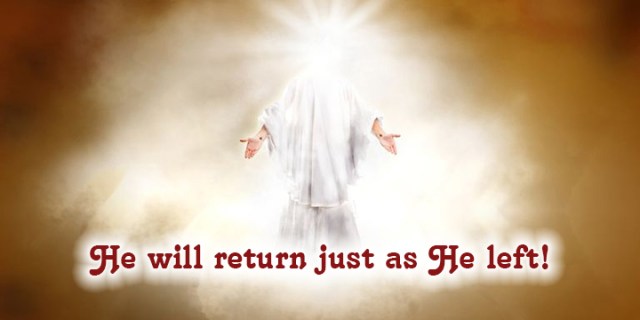
As He Went, So Will He Return!

Lesson based on Acts 1:3-11:

After Jesus is raised from death, He appears to his disciples. He proves to them that He is alive, and shows them how the Old Testament scriptures point to Him—in the Law, the history books, the Psalms and the Prophets.

Jesus particularly urges His disciples to wait in Jerusalem until God the Father sends them His Holy Spirit. They won’t have the grace or power to preach the gospel unless they are first plunged into the Holy Spirit, just as John the Baptist used to plunge people into water.

They must wait—prayerful and ready—for the Holy Spirit. Once they have received the Spirit they will be able to preach the Gospel not only in Jerusalem, but in the rest of Judea, among their old enemies the Samaritans and to the whole world.

The disciples still misunderstand “the kingdom of God.” They still expect Jesus to declare Himself as a military leader who will defeat the Romans and restore the kingdom of Israel. For Jesus, the kingdom of God isn’t a little political state of Israel, but a worldwide spiritual realm. It is everyone who welcomes His gospel. This is the gospel the apostles are to go out and preach. One day this kingdom will be complete, and Jesus will return—but only God the Father knows when that day will be.

Forty days after His resurrection, Jesus finally leaves His disciples. He leads them to the Mount of Olives, less than a mile outside Jerusalem. There, says Luke, “He was taken up, and a cloud received Him out of their sight.” – Luke 1:9.

All the New Testament writers know that Jesus ascended to heaven, but it is only Luke who describes it happening. He says Jesus went up as they looked towards heaven—an event as miraculous and unique as the resurrection itself.

The resurrection and ascension are two parts of the same act by which God the Father raises Jesus to His place in glory. The important idea is not that Jesus “lifted off” like a rocket-ship, but rather, that He was received into the glorious presence of God.

We don’t have to think of Jesus going up like a rocket. He “went up” as He is received into the high and holy presence of God, His Father. He is returning to His heavenly home from which He originally came down to earth from to fulfill His mission.

Luke says that “a cloud received Him out of their sight.” In the Old Testament, the cloud of God’s presence and glory surrounded the tent of meeting in the wilderness (Exodus 40:34). In his Gospel, Luke describes how a bright cloud enveloped Jesus when he met with Moses and Elijah on the Mount of Transfiguration (Luke 9:34–35).

The cloud symbolizes but also acts as a shield between God and human beings. It is a sign of His Holy presence. The angels tell the disciples that it is in this kind of “cloud of glory” that Jesus will one day return to take His followers home to be with the Father.

pd Jesus ascends

Unless otherwise noted, Scripture taken from the New King James Version®, NKJV © 1982 by Thomas Nelson.
Used by permission. All rights reserved.
Scripture links provided by Biblia.com
Posted in Pastor's Desk | Tagged , , , , , , , , , , , , , , , , , , , , , , , , , , , , , , , , , , , , , , , , , , , , , , | Leave a comment

We Want a King! – 1

expository teaching header 1

Scripture Text – 1 Samuel 7-11

For centuries, the people of Israel had looked to Jehovah as their King, but then they came to a point where they asked the Lord to give them a king just like the other nations. It was a critical time in the history of Israel, and it took the prayers and guidance of Samuel to bring them safely through this dangerous time of transition.

Seeking The Lord

Please read 1 Samuel 7:3-17 to get the background for this section.

After the battle with the Philistines and a temporary loss of the Ark of the Covenant and after its return, the Prophet Samuel discerned that the people were restless and were wanting change, and he knew that times of transition bring out either the best or the worst in people. God called Samuel to build a bridge between the turbulent age of the judges and the new era of the monarchy, for which they had asked and Samuel knew it wasn’t an easy task. There was one thing Samuel knew for certain: king or no king, the nation could never succeed if the people didn’t put the Lord first and trust only in Him. So he called for a meeting at Mizpah, a city in Benjamin (Joshua 18:26), where he challenged God’s covenant people to return to the Lord.

et false gods - idols

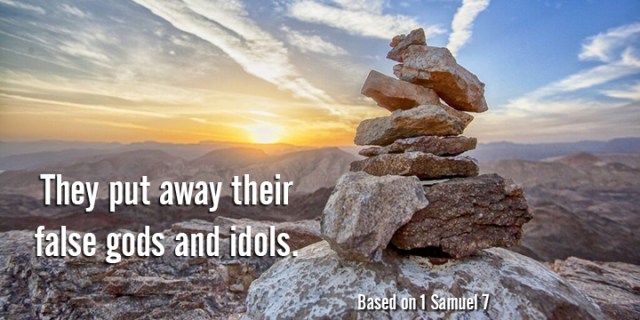
They put away their false gods (1 Samuel 7:3–4). Idolatry had been Israel’s most prevalent sin. Jacob’s family carried false gods with them (Genesis 35:2), and when the Jews were slaves in Egypt, they adopted the gods and goddesses of the Egyptians, and after the Exodus, worshiped some of those same idols during the wilderness journeys (Acts 7:42–43). Moses commanded Israel to destroy every evidence of Canaanite religion, but the people eventually lapsed back into idolatry and worshiped the gods of the defeated enemy. Samuel specifically mentioned the Baals and Ashtoreths (1 Samuel 7:3–4). Baal was the Canaanite storm god to whom the Jews often turned when the land was suffering drought, and Ashtoreth was the goddess of fertility whose worship included unspeakably sensual and sexual activities. At Mount Sinai, the Jews didn’t see a representation of God, but they heard His voice; and they knew that worshiping any image of their God was to practice false worship.

Putting away their false gods was only the beginning of their return to the Lord; the Jews also had to prepare their hearts for the Lord and devote themselves to the Lord alone. This was in keeping with the first commandment, “You shall have no other gods before me.” – Exodus 20:3. An idol is a substitute for God—anything that we trust and serve in place of the Lord, therefore it can be anything. The Jews gave themselves to worshipping idols of wood, stone, and metal, but believers today have more subtle and attractive gods: houses and lands, wealth, automobiles, boats, position and recognition, ambition, and even other people. Anything in our lives that takes the place of God as first and foremost in our lives and commands the sacrifice and devotion that belong only to Him, is an idol and must be cast out. Today, idols in the heart are far more dangerous than idols in the temple and in the church.

They confessed their sins (1 Samuel 7:5–6). Samuel planned to lead the people in a time of worship and intercession for deliverance from their enemies, but if they had iniquity in their hearts, he knew the Lord would not hear them (Psalm 66:18). It wasn’t enough to just destroy their idols; the people also had to acknowledge and confess their sins and surrender themselves to the Lord.

The key activity that day was their confession, “We have sinned against the Lord.” God’s covenant promise to Israel was that He would forgive their sins if they sincerely confessed them to Him (Leviticus 26:40–45), for no amount of sacrifices or rituals could wash away their sins. “The sacrifices of God are a broken spirit, a broken and a contrite heart—these, O God, you will not despise.” – Psalm 51:17. Later in Israel’s history, this promise of forgiveness and blessing was reiterated by Solomon at the dedication of the temple (2 Chronicles 7:14).

et prayer for forgiveness

They prayed for God’s help (1 Samuel 7:7–11, 13–14). When the Philistines learned about this large gathering of Jews at Mizpah, they became suspicious that Israel was planning to attack, so the five Philistine lords summoned their troops and prepared to invade. Israel had no standing army and no one ruler to organize one, so when they caught wind of the plan, they felt helpless. However, their greatest weapon was their faith in Jehovah God, a faith that was expressed in prayer. “Some trust in chariots, and some in horses; but we will remember the name of the Lord our God.” – Psalm 20:7. As we have seen, Samuel was a man of prayer (Psalm 99:6), and God answered him that day. As he sacrificed the evening burnt offering, the Lord thundered against the Philistine soldiers and so confused them that it was easy for Israel to attack and defeat them. When we remember that Baal was the Canaanite storm god, it makes the power of God’s thunder appear even more significant.

All the days of Samuel, the Lord kept the Philistines at a distance from Israel. Because of this victory, the Jews recovered cities they had lost in battle and even gained the Amorites as allies. Whenever God’s people depend on their own plans and resources, their efforts fail and bring disgrace to God’s name; but when God’s people trust the Lord and pray, He meets the need and receives the glory. A man or woman of prayer is more powerful than a whole army! No wonder King Jehoash called the Prophet Elisha “the chariots of Israel and their horsemen!” – 2 Kings 13:14. This was a title Elisha himself had used for his mentor Elijah (2 Kings 2:12 also see 2 Kings 6:17). Can we honestly state that we have such men and women of prayer today?

To Be Continued

explore bible footer

Adaptation of excerpts from Warren W. Wiersbe, Be Successful, “Be” Commentary Series.
Unless otherwise noted, Scripture taken from the New King James Version®, NKJV © 1982 by Thomas Nelson.
Used by permission. All rights reserved.
Scripture links provided by Biblia.com
Posted in Expository Teaching | Tagged , , , , , , , , , , , , , , , , , , , , , , , , , , , , , , , , , , , , , , , , , , , , , , | Leave a comment

Daily Prayer & Praise 10/10/2022

prayer and praise header 4
Prayer for Monday

Lord our God, we praise Your name because You have set up a mercy seat on earth, because You forgive our sins through the blood of Jesus Christ, our Lord and Redeemer. May Your mercy be seen at work in many hearts. Shed Your light upon all people, and let Your glory be known to all. Let Your glory shine upon all hearts, to the praise and glory of Your name and the deliverance of those who are still deep in the misery and bondage of sin. Keep us, Your children, in Your Word, which works miracles. Protect in us all that Jesus Christ has brought to the earth, and may we use His gifts in simplicity of heart. Grant that much may be accomplished to the glory of Your name and that we may draw nearer to the day of Jesus Christ, for which we wait in hope and longing. May Jesus come back for us quickly, and in His name we ask these things of You.

Amen.

prayer footer 2

Adapted from the Daily Written Prayers of Christoph Friedrich Blumhardt, 1842–1919. In Public Domain
Posted in Prayer and Praise | Tagged , , , , , , , , , , , , , , , , , , , , , , , , , , , , , , , , , , , , , , , , , , , , , , , , , , | Leave a comment

Queen Meets King of Kings

food for thought header 2
Dean Farrar was a privileged personal friend of Queen Victoria, though he seldom referred to the distinction. But on the first anniversary of the accession of Edward VII to the throne of England, during the service in Canterbury Cathedral, he told how the Queen, after hearing one of her chaplains preach at Windsor on the second coming of Christ, spoke to the Dean about it and said, “Oh, how I wish that the Lord would come during my lifetime.”

“Why does your Majesty feel this very earnest desire?” asked the great preacher.

With her queenly countenance lit up with deep emotion she replied, “Because I should so love to lay my crown at His feet.”

anecdotal story footer

Posted in Food For Thought | Tagged , , , , , , , , , , , , , , , , , , , , , , , , , , , , , , , , , , , , , | 4 Comments

Proud of Humility

thought of day header

Monday October 10, 2022

Romans 7:18
For I know that in me (that is, in my flesh) nothing good
dwells; for to will is present with me, but how
to perform what is good I do not find.

Three considerations should destroy pride forever within our breasts: the majesty of God, the enormity of our sins and the wonder of Christ’s redeeming death. But so tenacious is the root of Adam that we are often proud even of our want of pride. It is not uncommon to see holy men defending their holiness with positive violence and resenting any doubt cast upon their perfections.

For a Christian to claim credit for any good work is a violation of the most elementary teachings of the New Testament. Two things are taught clearly there: that I can of myself do no good thing; and if any good deed is done, it is the Lord Himself who has done it. That should settle our pride of service for good, but in fact it is not so. We still love to bask in the praise that our Christian efforts bring us.

For a Christian to revel in the praise he is accorded for some good work is as logically askew as for a singer to rush out and take a bow for another singer’s solo. It is a cheap form of robbery and must be exceedingly hateful to God.

thought of the day footer 2

Tozer on the Almighty God : A 366-Day Devotional (WingSpread, 2004)
Unless otherwise noted, Scripture taken from the New King James Version®, NKJV © 1982 by Thomas Nelson.
Used by permission. All rights reserved.
Posted in Daily Devotional | Tagged , , , , , , , , , , , , , , , , , , , , , , , , , , , , , , , , , , , , , , , , , , , , , | Leave a comment

God’s Command

nuff-said-header-2

ns 10-10 God's command

Posted in 'Nuff Said! | Tagged , , , , , , , , , , , , , , , , , , , , , , , , , , , , , , , , , , , , , | Leave a comment