Questions On Bible Prophecy – 6

prophetic words header wp

*Pastor’s Note: We will continue, in no particular order questions posed from the excellent book by Mark Hitchcock entitled, The Complete Book of Bible Prophecy. My hope and prayer is that it will give some insight into much of the end-times prophecy the Bible speaks of and hopefully alleviates some of the fears and confusion people have about studying prophecy. The following is the next in a line of questions I present to you from his book:

Why Is The Rapture Called a “Mystery”?

In 1 Corinthians 15:51, the apostle Paul refers to the Rapture as a “mystery” or “wonderful secret.” When we think of a mystery, we most often think of a story or event that is difficult to understand or solve. But in the New Testament, a mystery is a truth that is being revealed for the first time, and this is what Paul does in this passage. He reveals the mystery of the Rapture: “Let me tell you a wonderful secret God has revealed to us. Not all of us will die, but we will all be transformed” (1 Corinthians 15:51). The mystery of the Rapture is that some people will go to heaven and receive new, glorified bodies without ever dying. They will do an end run on the grave.

This was a completely new truth that God had never disclosed until 1 Corinthians 15:51. If you read the Bible from Genesis 1 to 1 Corinthians 14, you would correctly conclude that the only way to get to heaven in your glorified body would be to die. But in 1 Corinthians 15, that all changes. The Lord unveils this glorious mystery through Paul—that a whole generation of believers will be transformed without tasting the sting of physical death. Millions of believers will be transformed into their new, glorified bodies in the amount of time it takes to blink one’s eye. This is the glorious mystery of the Rapture. May we be the generation to experience this breathtaking event!


Mr. Hitchcock’s teachings are informative and enlightening as well as inspirational and any book you can get for yourself from his writings will most definitely be well-worth it. I hope you are blessed AND informed and some of these questions and answers will give you a greater strength to walk in confidence and faith in the Lord Jesus Christ.

Bible prophecy ALWAYS points to God and His plans for this world that He created through Christ Jesus. Therefore, for true Christians, it is meant to be a comfort that God continues as always to have everything under control despite what it might appear to the average person.

prophetic words footer

Mark Hitchcock, The Complete Book of Bible Prophecy (Tyndale House Publishers, Inc., 1999)
Scripture links provided by Biblia.com
Posted in Prophetic Words | Tagged , , , , , , , , , , , , , , , , , , , , , , , , , , , , , , , , , , , , , , , , , , , , , , , , , | Leave a comment

Sin Is Passed On Through Generations

life in focus header

PEOPLE often assume that their “private” sins hurt no one but themselves. For instance, how could the sin of envy affect anyone else? Isn’t coveting strictly a matter between them and the Lord?

But sins of character have a way of touching everyone with whom we have contact, especially those we love the most, our family. That is what happened in three generations of Isaac’s family. His wife, Rebekah, was determined to gain Isaac’s blessing for her favorite son, Jacob, even if it meant deceiving her husband (Genesis 25:28; 27:5–29). Thus she helped her son Jacob grow up to be a deceiver (27:35-36).

Years later, Jacob’s second wife, Rachel, became frustrated as her sister and rival, Leah, bore four sons for Jacob. Rachel’s anguish developed into such strong envy that it created tension and anger in her husband, even though he loved Rachel dearly (29:34–30:2).

A bitter harvest of Rebekah and Jacob’s deception and Rachel’s envy was reaped in the third generation when Joseph’s brothers began to envy him (37:11). They sold him into slavery and then deceived their father about it (37:23–35). Where had they learned to treat their sibling with jealousy and their father with such cruel deception? Clearly, they were following in their elders’ footsteps!

Sin can pass from generation to generation, not just by what is said, but by what is lived. Attitudes are not so much taught as caught.

life in focus footer

Courtesy of Nelson’s New Illustrated Bible Commentary
Scripture links provided by Biblia.com
Posted in Life In Focus | Tagged , , , , , , , , , , , , , , , , , , , , , , , , , , , , , , , , , , , , , , , , , , | Leave a comment

Centuries of Meditations – First Century 19-20

devotionals header

19

You never know yourself till you know more than your body. The Image of God was not seated in the features of your face, but in the lineaments of your Soul. In the knowledge of your Powers, Inclinations, and Principles, the knowledge of yourself chiefly consisteth. Which are so great that even to the most learned of men, their Greatness is Incredible; and so Divine, that they are infinite in value. Alas the WORLD is but a little centre in comparison of you. Suppose it millions of miles from the Earth to the Heavens, and millions of millions above the Stars, both here and over the heads of our Antipodes: it is surrounded with infinite and eternal space: And like a gentleman’s house to one that is travelling; it is a long time before you come unto it, you pass it in an instant, and leave it for ever. The Omnipresence and Eternity of God are your fellows and companions. And all that is in them ought to be made your familiar Treasures. Your understanding comprehends the World like the dust of a balance, measures Heaven with a span, and esteems a thousand years but as one day. So that Great, Endless, Eternal Delights are only fit to be its enjoyments.

20

The laws of GOD, which are the commentaries of His works, shew them to be yours: because they teach you to love God with all your Soul, and with all your Might. Whom if you love with all the endless powers of your Soul, you will love Him in Himself, in His attributes, in His counsels, in all His works, in all His ways; and in every kind of thing wherein He appeareth, you will prize Him, you will honor Him, you will delight in Him, you will ever desire to be with Him and to please Him. For to love Him includeth all this. You will feed with pleasure upon everything that is His. So that the world shall be a grand Jewel of Delight unto you: a very Paradise and the Gate of Heaven. It is indeed the beautiful frontispiece of Eternity; the Temple of God, and Palace of His children. The Laws of God discover all that is therein to be created for your sake. For they command you to love all that is good, and when you see well, you enjoy what you love. They apply the endless powers of your Soul to all their objects: and by ten thousand methods make everything to serve you. They command you to love all Angels and Men. They command all Angels and Men to love you. When you love them, they are your treasures; when they love you, to your great advantage you are theirs. All things serve you for serving them whom you love, and of whom you are beloved. The entrance of His words giveth Light to the simple. You are magnified among Angels and men: enriched by them, and happy in them.


Thomas Traherne (1637 – September 27, 1674) was an English poet, Anglican cleric, theologian, and religious writer. Traherne’s writings frequently explore the glory of creation and what he saw as his intimate relationship with God. His writing conveys an ardent, almost childlike love of God, and is compared to similar themes in the works of later poets William Blake, Walt Whitman, and Gerard Manley Hopkins. His love for the natural world is frequently expressed in his works.

The work for which Traherne is best known today is the Centuries of Meditations, a collection of short paragraphs in which he reflects on Christian life and ministry, philosophy, happiness, desire and childhood. This was first published in 1908 after having been rediscovered in manuscript ten years earlier. Before its rediscovery this manuscript was said to have been lost for almost two hundred years and is now considered a much loved devotional.

devotionals footer 2

Thomas Traherne, Centuries of Meditations, ed. Bertram Dobell (P. J. & A. E. Dobell, 1927)
Posted in Classic Devotionals | Tagged , , , , , , , , , , , , , , , , , , , , , , , , , , , , , , , , , , , , , , , , | Leave a comment

A Supernatural Book – John Linton – 10

great sermons header

gs john linton John Linton (1888 – 1965) John Linton is not normally listed among the elite of the evangelists in this century: Moody, Sunday, Bob Jones, Sr., Appelman, John Rice. But he was not some lesser light—God mightily moved through his ministry. He left a trail of converts to Christ as well as revived, restored, rejoicing churches.

His gospel soundness, his compelling delivery, his Scotch brogue and his devotion to our Lord made him widely acceptable. You cannot hear the inimitable Scotch brogue in his sermon, but you can enjoy its sweet and powerful message.

He died at age 77 in the pulpit while conducting evangelistic services.

The Bible – A Supernatural Book
The Wondrous Vitality of The Bible

All Scripture is given by inspiration of God . . . – 2 Timothy 3:16.

No book ever written has incurred such opposition as this Book. Kings, potentates and priests have sought to destroy it. The time was in Scottish history when to be found with a Bible meant death. Bible bonfires lighted the land.

Open infidelity outside the church has launched attack after attack upon this blessed Book. Infidelity in the pulpit, disguised as the friend of God, has sought to impugn its veracity. But the Bible still lives! Millions of copies of it, in over a thousand different languages, are being printed every year. Such vitality is a miracle.

Over two hundred years ago Voltaire, the French skeptic, said, “One hundred years from now the world will no more hear of the Bible.” Fifty years later, in the house of Voltaire in Paris where he uttered those words, the Geneva Bible Society was printing Bibles, while Voltaire has become a name “unwept, unhonored and unsung.”

Some years ago a first edition copy of the Bible sold for $106,000. About the same time the ninety-two volumes of the voluminous Voltaire sold at auction for eight shillings—about two cents each!

Psalm 2:4 says, “He that sitteth in the heavens shall laugh: the Lord shall have them in derision.”

If any reader is being tempted by the prevailing unbelief to doubt or deny the inspiration of this marvelous Book, let the foregoing facts give you hesitance.

The Bible is the Word of God. It is an everlasting Book.

“The grass withereth, and the flower thereof falleth away:
“But the word of the Lord endureth for ever.” – 1 Peter 1:24-25.

Our Lord believed it and quoted it with divine authority. He told us we would be judged by what was written in this Book:

“The word that I have spoken, the same shall judge him in the last day.” – John 12:48.

Three times He vanquished Satan on the mount by saying, “It is written …” If it was written in the Book, that settled it for Him. He Himself proclaimed its wondrous vitality when He said, “Heaven and earth shall pass away, but my words shall not pass away.” This we believe, and in all confidence we proclaim the Book to be a supernatural Book.

gs word of God 2

Unless otherwise noted, Scripture taken from the Holy Bible: King James Version. In Public Domain.
Posted in Great Sermons From The Past | Tagged , , , , , , , , , , , , , , , , , , , , , , , , , , , , , , , , , , , , , , , , , , , , , | Leave a comment

No Fear of Bad News

thought of day header

For Sunday October 16, 2022

Psalm 112:7
He will not be afraid of evil tidings; His heart is steadfast, trusting in the LORD.

At first reading, Psalm 112 seems too good to be true; but on further study, we realize it’s so good it must be true. This psalm explains how God blesses us when we praise Him, fear Him, and delight in His commandments (112:1).

Our children will be blessed by our faithfulness (112:2); our needs will be met (112:3); we’ll become more gracious, compassionate, and righteous (112:4); and more generous and discreet (112:5). Best of all, we’ll be secure in our hearts, unafraid of bad news (112:6–8).

This isn’t a promise that bad news will never come, for we all read the headlines every day and sometimes face that dreaded call in the night or those difficult conversations with a friend. But faith turns the bad news into topics of prayer and objects of trust, for we know God works all things together for those who love Him (Romans 8:28). Because of God’s sovereignty and Christ’s resurrection, we have a peace the world can never understand. Our hearts are “steadfast, trusting in the Lord.”

[The] peace of God … is an unspeakable calmness and serenity of spirit,
a tranquility in the blood of Christ, which keeps the souls of believers,
in their latest hour, even as a garrison keeps a city.

JOHN WESLEY

thought of the day footer 3

David Jeremiah, Turning Points with God: 365 Daily Devotions (Tyndale, 2014)
Unless otherwise noted, Scripture taken from the New King James Version®, NKJV © 1982 by Thomas Nelson.
Used by permission. All rights reserved.
Scripture links provided by Biblia.com
Posted in Daily Devotional | Tagged , , , , , , , , , , , , , , , , , , , , , , , , , , , , , , , , , , , , , , , , , , , , , , | Leave a comment

Known To Be

anecdotal stories

After he has suffered, he will see the light of life and be satisfied; by his knowledge my righteous servant will justify many, and he will bear their iniquities. – Isaiah 53:11.

He called you to this through our gospel, that you might share in the glory of our Lord Jesus Christ. – 2 Thessalonians 2:14.

Inheritance – All Christians Share

A lawyer in Los Angeles serves some of the biggest stars in show business, but he never gets calls, complaints, or requests from them. He is an agent for dead celebrities. Among his clientele are Marilyn Monroe, W. C. Fields, and Elvis Presley. What he actually does is watch commercial markets for merchandisers who use the likenesses and names of the deceased stars to sell their products without reimbursing the heirs. The lawyer insists that the heirs of famous people retain a continuing right to the fame their relative developed while alive.

Jesus personified everything about the kingdom that he taught—light, life, love, salvation. That is why he wants us to follow and learn of him. If we understand and follow him—living as he lived, thinking as he thought—we possess him, having the salvation that he is. In appropriating Christ personally, we possess light, life, love, and salvation. We are temples of God, filled with God! Incredible: to have such treasure in these jars of clay!

food for thought footer 2

Courtesy of Speaker’s Sourcebook of New Illustrations by Virgil Hurley © 1995 by Word, Incorporated.
Unless otherwise noted, Scripture taken from the Holy Bible, New International Version®, NIV © 2011 by Biblica, Inc.®
Used by permission. All rights reserved.
Posted in Anecdotal Stories | Tagged , , , , , , , , , , , , , , , , , , , , , , , , , , , , , , , | Leave a comment

A Morning Prayer

prayer and praise header 3
Thérèse of Lisieux, Prayer for Sunday 10-16-2022

O my God! I offer you all my actions of this day for the intentions and for the glory of the Sacred Heart of Jesus. I desire to sanctify every beat of my heart, my every thought, my simplest works, by uniting them to its infinite merits; and I wish to make reparation for my sins by casting them into the furnace of its merciful love.

O my God! I ask of you for myself and for those whom I hold dear, the grace to fulfill perfectly your holy will, to accept for love of you the joys and sorrows of this passing life, so that we may one day be united together in heaven for all eternity.

Amen.

pp 10-16 therese of lisieux

Elliot Ritzema, ed., 400 Prayers for Preachers (Lexham Press, 2012)
Posted in Prayer and Praise | Tagged , , , , , , , , , , , , , , , , , , , , , , , , , , , , , , , , , , , , , , , , , , , , | Leave a comment

Jesus Calls For Repentance – 2

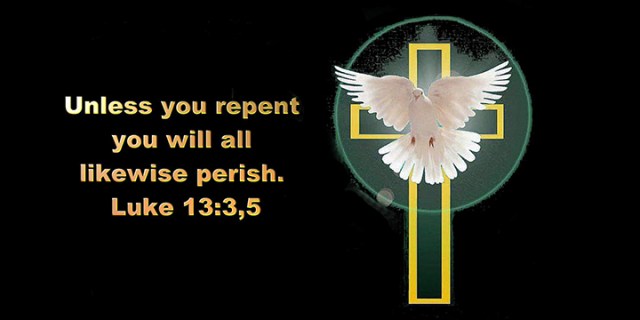
There were present at that season some who told Him about the Galileans whose blood Pilate had mingled with their sacrifices. And Jesus answered and said to them, “Do you suppose that these Galileans were worse sinners than all other Galileans, because they suffered such things? I tell you, no; but unless you repent you will all likewise perish. Or those eighteen on whom the tower in Siloam fell and killed them, do you think that they were worse sinners than all other men who dwelt in Jerusalem? I tell you, no; but unless you repent you will all likewise perish.”

He also spoke this parable: “A certain man had a fig tree planted in his vineyard, and he came seeking fruit on it and found none. Then he said to the keeper of his vineyard, ‘Look, for three years I have come seeking fruit on this fig tree and find none. Cut it down; why does it use up the ground?’ But he answered and said to him, ‘Sir, let it alone this year also, until I dig around it and fertilize it. And if it bears fruit, well. But if not, after that you can cut it down.’ ” – Luke 13:1-9.

Part Two

Jesus went on to explain that just as suffering is no indicator of one’s spiritual state, neither is tragedy. The Pharisees would have seen the previous incident as God’s judgment on the Zealots, but the Zealots would have seen this incident as God’s judgment against those who had compromised with Rome. Again, popular thought would have concluded that the “eighteen on whom the tower in Siloam fell and killed” must have been much “worse sinners than all other men who dwelt in Jerusalem;” otherwise they would not have suffered such a fate. The Zealots, a group of anti-Roman terrorists, would have said that the aqueduct workers deserved to die for cooperating. The Zealots would have considered Jews working on a Roman project such as this as traitors and therefore deserving of God’s punishment.

Again, Jesus explained that all people are sinners who must repent or they too will perish—and it will be a spiritual death with eternal consequences. He said that neither the Galileans nor the workers should be blamed for their calamity. Instead of blaming others, everyone should consider his or her own day of judgment. People never know when they will die and be called to face their Creator. Just as believers should be ready for any moment when Christ will return, so they should be ready for any moment when they could be taken in death. Whether a person is killed in a tragic accident or miraculously survives is not a measure of righteousness. Everyone has to die; that’s part of being human (See Hebrews 9:27). However, not everyone has to suffer death eternally. Jesus promised that those who repent of their sins and believe in Him will not perish but have eternal life (John 3:16).

Then after highlighting the need for repentance, Jesus told this parable to show the people that while God is gracious in giving people time to repent, come to him, and grow in him, that patience will not go on forever. In the Old Testament, a fruitful tree was often used as a symbol of godly living (see, for example, Psalm 1:3 and Jeremiah 17:7–8). Jesus pointed out what would happen to the other kind of tree—the kind that took valuable time and space and still produced nothing for the patient gardener. In this way, Jesus warned His listeners that God would not tolerate forever their lack of productivity. (See Luke 3:9 for John the Baptist’s version of the same message.) A fig tree in the fertile soil of a vineyard should certainly have produced fruit—a tree that did not produce “for three years” was probably not going to produce at all. The farmer gave the command to “cut it down” so another, more fruitful tree could be planted in its place.

pd luke 3_9

The gardener, however, intervened and asked the owner to give the tree just one more chance. He even offered to give it special attention and fertilizer. Jesus had come to the nation; the time for repentance had come. The extra attention and love had been showered on the nation in the presence of their Messiah. God’s judgment had been graciously held back. But if the people continued to refuse to “bear fruit” for God—if they continued to refuse to live for and obey him—judgment would come. There would be no more chances. God is merciful toward sinners. But for those who outright reject him, he will not be merciful forever. They will be punished.

In closing remember that Jesus dismissed ideas widespread in His day that accidents or human cruelties were God’s judgment on especially wicked and corrupt sinners. Why else would some die and others live? Jesus did not answer that question but instead pointed to everyone’s need for repentance.

Today people experience grief due to car accidents, airplane disasters, natural disasters, or even violent crime. They often ask why, and they struggle to understand the unfairness of the loss. Jesus pointed to the only answer: God’s grace. Accepting Jesus as Lord and Savior is the only remedy. When disaster strikes, God’s promises will sustain you.

God patiently and steadfastly allows more time. If you have suffered something that has spoiled your life for a long time and many people have given up on you, God will not. Maybe you’ve given up on yourself. However, God has not nor ever will give up on you. Give your problems to Him. Just recognize that God’s patience, though very long, is not forever. As Jesus taught, today is the day to repent!


Unless otherwise noted, Scripture taken from the New King James Version®, NKJV © 1982 by Thomas Nelson.
Used by permission. All rights reserved.
Scripture links provided by Biblia.com
Posted in Pastor's Desk | Tagged , , , , , , , , , , , , , , , , , , , , , , , , , , , , , , , , , , , , , , , , , , , , , , , , | 1 Comment

We Want a King! – 5

expository teaching header 1

Scripture Text – 1 Samuel 7-11

For centuries, the people of Israel had looked to Jehovah as their King, but then they came to a point where they asked the Lord to give them a king just like the other nations. It was a critical time in the history of Israel, and it took the prayers and guidance of Samuel to bring them safely through this dangerous time of transition.

Obeying The Lord – Continued

Please read 1 Samuel 9:1-10:27 to get the background for this section.

Samuel anoints Saul (1 Samuel 9:26-10:16). Early the next morning, Samuel accompanied Saul and his servant to the edge of the city, sent the servant on ahead, and then anointed Saul as the first king of Israel. From that moment on, Saul was leader over God’s people (“inheritance”), but only Samuel and Saul knew it. Samuel gave Saul three signs, special occurrences he would encounter as he made his way home to let Saul know God had chosen him.

First, he would meet two men who would tell him that the lost animals had been found, news that Saul had already heard from Samuel. Apparently these men knew who Saul was and that he had been away from home seeking the lost property. But this was a good experience for the young king, for it assured him that God could solve his problems. One of Saul’s greatest failures as a leader was his inability to take his hands off of situations and let God work. So it is in our day and age. Yet while Saul and his servant were dining with Samuel, God was already at work.

The second sign would take place at the oak of Tabor where he would meet three pilgrims heading for Bethel. In spite of the nation’s unbelief, there were still devoted people in the land who honored the Lord and sought Him. There must have been a sacred place at Bethel dedicated to the Lord (Judges 20:18, 26), and perhaps the three kids, the wine, and the three loaves of bread were gifts for the Levites serving there. Since as yet there was no central sanctuary, the three kids may have been for sacrifices. These men would greet Saul and give him two of the three loaves, and he was to receive them. God was showing Saul that not only could He solve his problems, but He could also supply his needs. As the first king of Israel, he would have to raise up an army and provide the food and equipment the men needed, and he would have to depend on the Lord to accomplish that.

The third sign had to do with spiritual power. Saul would meet a band of prophets returning from worship at the high place, and they would be prophesying. The Holy Spirit of God would come upon Saul at that time and he would join the company of prophets in their ecstatic worship. In this sign, God told Saul that He could endue him with the power he needed for service. “And who is sufficient for these things?” – 2 Corinthians 2:16. That is the question that should be in the heart of every servant of God, and the only correct answer is “our sufficiency is of God.” – 2 Corinthians 3:5. However, later Saul would become very self-sufficient and rebellious, and the Lord would ultimately take His Spirit from him (1 Samuel 16:14; 28:15).

et 1 samuel 10_6

When Saul turned from Samuel to start his journey home, “God gave him another heart.” Don’t misinterpret this statement; it refers primarily to a different attitude and outlook, not “regeneration.” This young farmer would now think and act like a leader, the king of the nation, a warrior-statesman whose responsibility it was to listen to God and obey His will. As Samuel told him, the Holy Spirit would further enable him to serve God as long as he walked in obedience to God’s will. Because Saul eventually became proud and independent and rebelled against God, he lost the Spirit’s power and anointing, he lost his kingdom, and he eventually lost his life.

Each of these events took place just as Samuel promised, but the only one actually described in the text is Saul’s encounter with the company of prophets. In the Old Testament era, God gave His Holy Spirit to chosen people to enable them to perform special tasks, and God could take the Spirit away as well. Believers today, who are under the New Covenant, have the Holy Spirit abiding within forever (John 14:16–17) as God’s seal that we are His children (Ephesians 1:13–14). When David asked God not to take the Holy Spirit from him (Psalm 51:11), he was most likely thinking especially of what the Lord did to Saul. Believers today may grieve the Spirit (Ephesians 4:30) and quench the Spirit (1 Thessalonians 5:19), but they cannot drive Him away.

The Spirit enabled Saul to have a personal experience with the Lord and to express it in praise and worship. Had Saul continued to nurture this walk with the Lord, his life would have been much different. His pride and desire for power became his conquering sin. When the news got out that Saul had prophesied with a company of prophets, some of his friends spoke about him with disdain. However, there’s no evidence that he was overly wicked, but Saul was a secular person, not a spiritual person, and he was the last man his friends ever expected to have that kind of experience. Even after Saul was presented to the people as their king, not everybody in Israel was impressed with him.

Saul returned home and went back to work on the farm as though nothing remarkable had happened. He said nothing to his family about being anointed king, and apparently the news about his prophetic experiences hadn’t yet reached as far as Gibeah. The experiences of the previous days should have taught him that God was with him, and that He would take care of him and meet his needs, if only he would trust and obey. He also should have realized that he could trust Samuel to give him God’s message, and that to disobey Samuel meant to disobey the Lord. One more task awaited Saul, and that was to meet Samuel at Gilgal at a time that would be shown him. This would be a test to see if Saul was truly devoted to the Lord and willing to obey orders. Unfortunately, he failed.

To Be Continued

explore bible footer

Adaptation of excerpts from Warren W. Wiersbe, Be Successful, “Be” Commentary Series.
Unless otherwise noted, Scripture taken from the New King James Version®, NKJV © 1982 by Thomas Nelson.
Used by permission. All rights reserved.
Scripture links provided by Biblia.com

Posted in Expository Teaching | Tagged , , , , , , , , , , , , , , , , , , , , , , , , , , , , , , , , , , , , , , , , , , , , | Leave a comment

Daily Prayer & Praise 10/14/2022

prayer and praise header 4
Prayer for Friday

Lord our God, You are help, comfort, and life to us in everything we have to endure. We come before You as poor, weak people, but You can make us rich in spirit and give us new life so that our lives prove we hold to Your will and to the justice You bring on earth. May we be one in spirit through all we experience in our hearts, to the glory of Your name. May the praise and thanks of many people ring out into all the world because You are help and deliverance from all evil and the darkness pervading the world. We ask that You continue to strengthen us and polish us to a brilliance that will show the world the light of Jesus. In His name we ask this of You.

Amen.

prayer footer 2

Adapted from the Daily Written Prayers of Christoph Friedrich Blumhardt, 1842–1919. In Public Domain
Posted in Prayer and Praise | Tagged , , , , , , , , , , , , , , , , , , , , , , , , , , , , , , , , , , , , , , , , , , , , , , , , , , | Leave a comment

Setting The Sails

food for thought header 2
When Hudson Taylor, the famous missionary, first went to China, it was in a sailing vessel. Very close to the shore of cannibal islands the ship was becalmed, and it was slowly drifting shoreward unable to go about and the savages were eagerly anticipating a feast.

The captain came to Mr. Taylor and besought him to pray for the help of God. “I will,” said Taylor, “provided you set your sails to catch the breeze.” The captain declined to make himself a laughing stock by unfurling in a dead calm. Taylor said, “I will not undertake to pray for the vessel unless you will prepare the sails.” And it was done.

While engaged in prayer, there was a knock at the door of his stateroom. “Who is there?”

The captain’s voice responded, “Are you still praying for wind?”

“Yes,” stated Hudson.

“Well,” said the captain, “you’d better stop praying, for we have more wind than we can manage.”

anecdotal story footer

Posted in Food For Thought | Tagged , , , , , , , , , , , , , , , , , , , , , , , , , , , , , , , , , , , , , , | Leave a comment

2 Corinthians 13:5

thought of day header

Friday October 14, 2022

2 Corinthians 13:5
Examine yourselves as to whether you are in the faith. Test yourselves.

Here, too, we notice the distinct line of demarcation which separates the righteous person from the hypocrite and the self-deceived person.

Hypocrite persons fear self-examination and avoid it at all costs. Gradually they acquire much practice in comforting themselves and defending themselves against the restless thoughts which the Spirit of God puts into their conscience.

The righteous fear self-examination also. But they desire it nevertheless; and seek it. They desire to know the truth about themselves, even though it results in the passing of judgment upon their Christian life.

The righteous permit the light of God to be shed upon all their sins and desires. They desire to know at all times whether they have entered into a compact with any sin as a result of which they may be excusing and defending sin in themselves.

They desire to know if there is anything in which they do not desire to know the will of God. They know that there are instances enough in which they are not able to do the will of God, but this does not disturb them as long as they are conscious of the fact that they are not seeking in willfulness or love of ease to explain away the will of God.

Nor do sincere souls stop at this.

They have learned to have a holy lack of confidence in themselves, also in their own self-examination. Therefore they ask the Lord to try them. As the old psalmist did: “Search me, O God, and know my heart!… And see if there be any wicked way in me, And lead me in the way everlasting!”

And God hears their prayer and points now to one, now to another thing in their lives which is contrary to the will of God. The result is sorrow, distress, and shame. And the soul’s hunger and thirst for grace is kept alive, yes, experiences a normal growth. Faith fights the good fight and keeps healthy and sound. The cross becomes a place of refuge.

Joy and sorrow, smiles and tears mingle there as they are mingled in life.

thought of the day footer 5

O. Hallesby, God’s Word for Today: A Daily Devotional for the Whole Year, translator Clarence J. Carlsen (Augsburg, 1994)
Unless otherwise noted, Scripture taken from the New King James Version®, NKJV © 1982 by Thomas Nelson.
Used by permission. All rights reserved.
Posted in Daily Devotional | Tagged , , , , , , , , , , , , , , , , , , , , , , , , , , , , , , , , , , , , , , , , , , , , , | Leave a comment

God’s Word, Our Sure Foundation

nuff-said-header-2

ns 10-14 God's word, our foundation

Posted in 'Nuff Said! | Tagged , , , , , , , , , , , , , , , , , , , , , , , , , , , , , , , , , , , , , | Leave a comment

Reflecting With God 10/14/2022

reflecting with God header
Thinking, praying, reading, studying the Bible – when we do these things, we are reflecting on the Word of God. To reflect is to contemplate and/or consider, and God wants us to deeply reflect on His Word so that we can better understand Him.

Friday Reflecting

So Ahab went up to eat and drink. And Elijah went up to the top of Carmel; then he bowed down on the ground, and put his face between his knees . . . Then the hand of the LORD came upon Elijah; and he girded up his loins and ran ahead of Ahab to the entrance of Jezreel. – 1 Kings 18:42, 46.

In driving piles, a machine is used by which a huge weight is lifted up and then made to fall upon the head of the pile. Of course the higher the weight is lifted the more powerful is the blow which it gives when it descends. Now, if we would tell upon our age and come down upon society with ponderous blows, we must see to it that we are uplifted as near to God as possible. All our power will depend upon the elevation of our spirits. Prayer, meditation, devotion, communion, are like a windlass to wind us up aloft: it is not lost time which we spend in such sacred exercises, for we are thus accumulating force, so that when we come down to our actual labor for God, we shall descend with an energy unknown to those to whom communion is unknown.
~ C. H. SPURGEON

reflecting with God footer 2

Unless otherwise noted, Scripture taken from the New King James Version®, NKJV © 1982 by Thomas Nelson.
Used by permission. All rights reserved.
Posted in Reflecting With God | Tagged , , , , , , , , , , , , , , , , , , , , , , , , , , , , , , , , , , , , , , , , , , , , , | Leave a comment

Jesus Calls For Repentance – 1

There were present at that season some who told Him about the Galileans whose blood Pilate had mingled with their sacrifices. And Jesus answered and said to them, “Do you suppose that these Galileans were worse sinners than all other Galileans, because they suffered such things? I tell you, no; but unless you repent you will all likewise perish. Or those eighteen on whom the tower in Siloam fell and killed them, do you think that they were worse sinners than all other men who dwelt in Jerusalem? I tell you, no; but unless you repent you will all likewise perish.”

He also spoke this parable: “A certain man had a fig tree planted in his vineyard, and he came seeking fruit on it and found none. Then he said to the keeper of his vineyard, ‘Look, for three years I have come seeking fruit on this fig tree and find none. Cut it down; why does it use up the ground?’ But he answered and said to him, ‘Sir, let it alone this year also, until I dig around it and fertilize it. And if it bears fruit, well. But if not, after that you can cut it down.’ ” – Luke 13:1-9.

Previous to the exhortation that follows, Jesus admonished the people to realize their predicament, that judgment was just around the corner. Then here, Jesus took the sudden and terrifying deaths of some innocent people to illustrate their tragic circumstances. Still stunned by the grisly murders, the people were, in effect, told by Jesus that they faced a similar fate—but it would be eternal death, much worse than physical death.

Jesus used a current event to drive home a point. The people were wondering whether those who had suffered so much were being specially judged by God. But Jesus forced them to consider whether they themselves were still under God’s judgment, a fate even more horrifying than what happened to the people that Pilate murdered. Jesus often used this way of teaching. He didn’t let people sit back and analyze a subject; instead, he frequently confronted them, pressing them to reevaluate their lives in light of God’s perfect law. We all need to set aside a time to evaluate our speech, thought, and actions, according to God’s standards and still leave enough time to confess our faults to the Lord and to receive the forgiveness we need to start fresh.

As most of us already know, Pontius Pilate was the Roman governor of the province of Judea from A.D. 26 to 36. The city of Jerusalem, the site of Temple, lay within his jurisdiction. Pilate was known to be a harsh man, and held outright contempt for the Jewish people. Being stationed to rule such people in a far outpost of the Roman Empire probably hurt his pride and made the prospect of further promotion highly unlikely, so he took pleasure in demonstrating his authority over the Jewish people. At one point, he impounded money from the temple treasuries to build an aqueduct; another time, he insulted Jewish sensibilities by bringing imperial images into the city.

Pilate had a small contingent of soldiers, and his main duty was to keep the peace (called Pax Romana) that ancient Rome imposed on all its conquered territories. While no other historical source refers to the event that the people asked Jesus about, it is completely in Pilate’s character for it to have happened. Galilee was a hotbed for fanatics who sought to bring down Rome by force. Galilee, itself was out of Pilate’s jurisdiction, but when some Galileans arrived in Jerusalem, they were murdered. Pilate may have heard that these people were plotting a revolt.

Jesus, true to His style, used this event to teach a lesson about suffering and evil in the world.

We need to understand that Jewish theology attributed individual suffering to individual sin. While the Pharisees would also have liked to see Israel freed from Roman control, they were against the use of force that many in Israel (such as a group called the Zealots) were advocating. Some people, such as the Pharisees and their followers, would have thought that these Galileans who were murdered must have been “worse sinners than all other Galileans” because they had suffered in that horrific way. The Pharisees, who were opposed to using force to deal with Rome, would have said that the Galileans deserved to die for rebelling.

However, Jesus explained that suffering has nothing to do with one’s spiritual state. In fact, all people are sinful, and unless all people repent, they “will all likewise perish.” Of course, this doesn’t mean that everyone will be killed in such a manner. It could mean that death will be sudden with no second chance to repent, or it could mean that Jesus’ listeners would suffer at the hands of the Roman conquerors (which the entire nation did in A.D. 70 when Jerusalem was destroyed and millions of Jews were killed).

To Be Continued

pd repentance

Unless otherwise noted, Scripture taken from the New King James Version®, NKJV © 1982 by Thomas Nelson.
Used by permission. All rights reserved.
Posted in Pastor's Desk | Tagged , , , , , , , , , , , , , , , , , , , , , , , , , , , , , , , , , , , , , , , , , , , , , , , , | Leave a comment

We Want a King! – 4

expository teaching header 1

Scripture Text – 1 Samuel 7-11

For centuries, the people of Israel had looked to Jehovah as their King, but then they came to a point where they asked the Lord to give them a king just like the other nations. It was a critical time in the history of Israel, and it took the prayers and guidance of Samuel to bring them safely through this dangerous time of transition.

Obeying The Lord

Please read 1 Samuel 9:1-10:27 to get the background for this section.

The focus now shifts from Samuel to Saul, God’s choice for Israel’s king. He was from the tribe of Benjamin, which had almost been exterminated because of their rebellion against the law (Judges 19–20). Jacob compared Benjamin to “a ravening wolf” (Genesis 49:27), and the tribe was involved in numerous battles. Benjamin’s territory lay between Ephraim and Judah, so Saul’s tribe was adjacent to the royal tribe of Judah. In spite of what Saul modestly said to Samuel when they met, he belonged to a powerful and wealthy family that owned real estate and animals and had servants.

Physically, Saul was tall, good-looking, and strong, the kind of king people would admire. Even Samuel, with all his spiritual perception, got carried away when he saw him (1 Samuel 10:23–24). His weakness for admiring the physical qualities even showed up when Samuel went to anoint David (1 Samuel 16:1–7). Saul was obedient to his father and concerned about his father’s feelings, and he was persistent in wanting to obey his father’s will. To invest all that time and energy looking for the lost animals suggests that he wasn’t a quitter. There was a certain amount of modesty in Saul (1 Samuel 9:21; 10:14–16), however there was no indication whatsoever of a spiritual lifestyle.

Samuel meets Saul (1 Samuel 9:1-25). Saul’s home was in Gibeah, which was about five miles from Ramah where Samuel lived, and yet Saul didn’t even know what all Israel knew, that a man of God named Samuel lived in Ramah. How Saul could live so close to Israel’s spiritual leader and not know about him is a bit of a mystery and suggests that Saul simply lived and farmed with his family at Gibeah and minded his own business. Apparently he didn’t attend the annual feasts and wasn’t greatly concerned about spiritual matters. Like many people today, he wasn’t against religion, but he didn’t make knowing the Lord a vital part of his life. It’s a good thing the servant knew about Samuel and that Saul heeded his advice!

et lost donkeys

A rather insignificant event brought Saul and Samuel together—the loss of some of Kish’s donkeys. The animals were valuable, of course, and later somebody found them and returned them to Kish, but who would have thought that Israel’s first king would be called to the throne while searching for donkeys! David was identified with sheep (Psalm 78:70–72; 1 Samuel 17:15) and saw the people of Israel as sheep who needed protection and guidance (2 Samuel 24:17). The Lord works in unusual ways, but if Saul had not obeyed his father and listened to his servant, the story might have been different.

It was evening when the two men arrived at the gates of Ramah, because the young ladies were going out to draw water. Asking the girls if the seer, which the early prophets were called, was there, they were given a long detailed answer. Perhaps the Jewish maids were happy to chat with a tall, handsome stranger! Even the time of Saul’s arrival at the city was providential, for Samuel appeared just as Saul and his servant entered the city. Samuel was going up to a “high place” outside the city where he would offer a sacrifice to the Lord. Since there was no central sanctuary in Israel at that time, the people brought their sacrifices to a shrine that was dedicated to the Lord and located on a hill near the city. The pagan nations worshiped their false gods at the high places and also indulged in filthy practices there, but the people of Israel were forbidden to join with them (Psalm 78:58; Hosea 4:11–14; Jeremiah 3:2).

The day before, the Lord had told Samuel that Saul was coming to Ramah, so he was prepared to meet him and give him God’s message. Samuel couldn’t say he was happy about the changes going on in Israel, but he was obedient to the Lord. When Saul appeared, the Lord spoke again to Samuel and confirmed that this was indeed the man of His choice and that Samuel should anoint him as king. “God’s anointed” was one of the titles for the king (1 Samuel 12:3; 24:6; 26:9, 11, 16; Psalm 2:2, 6). The Lord would use Saul just as He did Samson (Judges 13:5), to begin to weaken the Philistines and prepare them for David’s final conquest of this enemy of the Jews (1 Chronicles 18:1).

Samuel’s response to Saul’s request must have shocked the young man when Samuel identified himself as the one Saul was seeking. It must have further surprise him that he would feast with him that day, that Samuel had a special message for him, and that the missing donkeys had been found and returned to his father. Furthermore, all the desires of Israel was fixed on Saul, because all Israel wanted a king. Saul didn’t understand what Samuel was saying, but everything would be explained to him the next day. Samuel ignored Saul’s protest that he was a nobody who belonged to an insignificant tribe, and he escorted Saul and his servant to the banquet hall at the high place where the feast would be held. Saul was given the special portion of the fellowship offering that belonged to the priest (see Leviticus 7:32–33), and the cook informed him that the portion had been set aside especially for him. Strange things were happening! After the feast, Saul returned with Samuel to his house, and there they had a long talk in which Samuel rehearsed for Saul the events that had led up to this meeting.

To Be Continued

explore bible footer

Adaptation of excerpts from Warren W. Wiersbe, Be Successful, “Be” Commentary Series.
Unless otherwise noted, Scripture taken from the New King James Version®, NKJV © 1982 by Thomas Nelson.
Used by permission. All rights reserved.
Scripture links provided by Biblia.com

Posted in Expository Teaching | Tagged , , , , , , , , , , , , , , , , , , , , , , , , , , , , , , , , , , , , , , , , , , , , , , | Leave a comment

Daily Prayer & Praise 10/13/2022

prayer and praise header 4
Prayer for Thursday

Dear Father in Heaven, we come before You as Your children, longing to be assured through Your Spirit that we are and may remain Your children. We long to live to the glory of Your name under the shelter and guidance of the Lord Jesus in expectation of the great day which shall fulfill all promises made to us. Strengthen us, especially in dark and troubled days. Help us when danger threatens and when evil tries to make headway among us. Allow Your Holy Spirit to flow into us with the awesome of gift of discernment and help us to remain ever alert and vigilant against the ever increasing darkness. Deliver us from all evil, for Yours is the Kingdom, the power, and the glory for ever and ever. In the name of Jesus Christ, Lord of lords and King of kings.

Amen.

prayer footer 2

Adapted from the Daily Written Prayers of Christoph Friedrich Blumhardt, 1842–1919. In Public Domain
Posted in Prayer and Praise | Tagged , , , , , , , , , , , , , , , , , , , , , , , , , , , , , , , , , , , , , , , , , , , , , , , , , , | Leave a comment

Pulling On Both Oars

food for thought header 2
An old Scotsman operated a little rowboat for transporting passengers. One day a passenger noticed that the good old man had carved on one oar the word “Faith,” and on the other oar the word “Works.” Curiosity led him to ask the meaning of this. The old man, being a well-balanced Christian and glad of the opportunity for testimony, said, “I will show you.”

So saying, he dropped one oar and plied the other called Works, and they just went around in circles. Then he dropped that oar and began to ply the oar called Faith, and the little boat just went around in circles again—this time the other way around, but still in a circle.

After this demonstration the old man picked up Faith and Works and plying both oars together, sped swiftly over the water, explaining to his inquiring passenger, “You see, that is the way it is in the Christian life. Dead works without faith are useless, and “faith without works is dead” also, getting you nowhere. But faith and works pulling together make for safety, progress, and blessing.”

anecdotal story footer

Posted in Food For Thought | Tagged , , , , , , , , , , , , , , , , , , , , , , , , , , , , , , , , , , , , , | Leave a comment

Individual Discouragement and Personal Enlargement

thought of day header

Thursday October 13, 2022

Exodus 2:11
When Moses was grown . . . he went out to his brethren and looked at their burdens.

Moses saw the oppression of his people and felt certain that he was the one to deliver them, and in the righteous indignation of his own spirit he started to right their wrongs. After the first strike for God and for the right, God allowed Moses to be driven into blank discouragement, He sent him into the desert to feed sheep for forty years. At the end of that time, God appeared and told Moses to go and bring forth His people, and Moses said—‘Who am I, that I should go?’ In the beginning Moses realized that he was the man to deliver the people, but he had to be trained and disciplined by God first. He was right in the individual aspect, but he was not the man for the work until he had learned communion with God.

We may have the vision of God and a very clear understanding of what God wants, and we start to do the thing; then comes something equivalent to the forty years in the wilderness, as if God had ignored the whole thing, and when we are thoroughly discouraged God comes back and revives the call, and we get the quaver in and say—‘Oh, who am I!’ We have to learn the first great stride of God—“I AM THAT I AM hath sent thee.” We have to learn that our individual effort for God is an impertinence; our individuality is to be rendered incandescent by a personal relationship to God (see Matthew 3:11). We fix on the individual aspect of things; we have the vision—‘This is what God wants me to do’; but we have not got into God’s stride. If you are going through a time of discouragement, there is a big personal enlargement ahead.

thought of the day footer 4

Oswald Chambers, My Utmost for His Highest: Selections for the Year (Oswald Chambers Publications; Marshall Pickering, 1986)
Unless otherwise noted, Scripture taken from the New King James Version®, NKJV © 1982 by Thomas Nelson.
Used by permission. All rights reserved.
Scripture links provided by Biblia.com

Posted in Daily Devotional | Tagged , , , , , , , , , , , , , , , , , , , , , , , , , , , , , , , , , , , , , , , , , , , , , , | Leave a comment

God’s Love Endures!

nuff-said-header-2

ns 10-13 gods love endures

Posted in 'Nuff Said! | Tagged , , , , , , , , , , , , , , , , , , , , , , , , , , , , , , , , , , , , , | Leave a comment