Reflecting With God 9/26/2022

reflecting with God header
Thinking, praying, reading, studying the Bible – when we do these things, we are reflecting on the Word of God. To reflect is to contemplate and/or consider, and God wants us to deeply reflect on His Word so that we can better understand Him.

Monday Reflecting

“‘Curse Meroz,’ said the angel of the LORD, ‘Curse its inhabitants bitterly, Because they did not come to the help of the LORD . . . against the mighty.’” – Judges 5:23.

“Curse ye Meroz. By whose authority? The angel of the Lord’s. What has Meroz done? Nothing. Why then is Meroz to be cursed? Because he did nothing. What ought Meroz to have done? Come to the help of the Lord. Could not the Lord do without Meroz? The Lord did do without Meroz. Did the Lord sustain, then, any loss? No, but Meroz did. Is Meroz then to be cursed? Yes, and that bitterly. Is it right that a man should be cursed for doing nothing? Yes, when he ought to do something. Who says so? The angel of the Lord. ‘That servant which knew his Lord’s will, and did it not, shall be beaten with many stripes.’”
~ D. L. MOODY

reflecting with God footer 2

Unless otherwise noted, Scripture taken from the New King James Version®, NKJV © 1982 by Thomas Nelson.
Used by permission. All rights reserved.
Posted in Reflecting With God | Tagged , , , , , , , , , , , , , , , , , , , , , , , , , , , , , , , , , , , , , , , , , , , , , | Leave a comment

Beware of False Teachers and Teaching

A while back I did a series of expository teachings on the small letter that Jude wrote to believers. I want to reiterate something from that letter today because of the onslaught of falsehood that is confronting Christians today. Sadly, the ones most affected are the young in the Lord (age has nothing to do with it) and those that don’t, for whatever reason, get in and spend time in the written Word of God.

In verse 3, Jude writes:

“Beloved, while I was very diligent to write to you concerning our common salvation, I found it necessary to write to you exhorting you to contend earnestly for the faith which was once for all delivered to the saints.”

The word “delivered” in this verse could also be translated, “entrusted.” It was given to us for safe-keeping and to hold on to dearly as one would a keepsake.

Although Jude’s brief letter does not mention his intended readers, it addresses specific concerns about false teaching that was threatening the churches even in his day. Yet it doesn’t seem to have been Jude’s original intention. He stated he wanted to write to encourage believers. However, an urgent concern about false teaching caused him to write this letter denouncing the false teachers and appealing to the Christians to “contend earnestly for the faith” instead. Jude probably wanted this letter to be circulated because false teaching was a serious problem for all the churches. Thus, he specified no particular church or area.

The believers were addressed as “beloved” (also translated, “dear friends”), a term often used by those who wrote with authority to the Christians. (For example, Paul used the term in 1 Corinthians 10:14; Peter, in 1 Peter 2:11 and 2 Peter 3:1; John, in 1 John 2:7 and 3:2.) Jude had wanted to write a joyous letter to believers “concerning our common salvation,” that is, a letter about the Christian faith that he and all believers had in common. Instead, Jude had to set that idea aside because a much more urgent and unhappy topic needed to be addressed. False teachers were threatening the churches, endangering the believers’ faith.

pd fight for faith

The word “contend,” epagonizesthai, in the original Greek, occurs only here in the New Testament. Often it is used in secular literature to describe the intense struggle in an athletic contest. Jude called the believers to action, to contend for the faith. CONTENDING would not be easy; it called for hard work, diligent study, willingness to stand against society’s desire to water down the gospel, speaking up for the truth and bearing the burden of interpreting the timeless truth to a changing society. The believers could not (and would never be able to) sit back and idly enjoy the mercy, peace, and love of their faith (verse 2). Rather, their Christian faith must be defended against the onslaught of false teaching. “The faith” refers to the entire body of beliefs taught by the apostles and held by the Christians (see Acts 2:42). The teachings of Christ and his apostles had been “once for all” (without change to the content) “delivered to the saints” (to all believers). All Christians had been entrusted with the faith—to keep it pure and to teach it to others. Therefore, all Christians should stand ready to defend the faith as they would defend any prized possession.

Jude emphasized the important relationship between correct doctrine and true faith. The truth of the Bible must not be compromised because it gives us the real facts about Jesus and salvation. The Bible is inspired by God through His Holy Spirit and should never be twisted or manipulated as so often happens today.

DO NOT COMPROMISE

How do ordinary Christians contend for the truth today? Take some time to think about these ideas:

  • It is every Christian’s job to study the Bible. Don’t ever imagine that pastors and seminary professors hold a monopoly on this task. Without study, you cannot know what to contend for.
  • Knowledge in the brain is only part of contending for truth. Prayer is vital. God gives the Holy Spirit as a teacher. Unattached to God, you may know everything, but understand nothing. Knowledge without wisdom and understanding is empty.
  • Many private interpretations fracture the truth of the gospel; Christians must remain unified on the essentials. They must keep everything within the context with which it was written. Associate with a church or a group of believers that loves God and encourages learning. Then use your common resources for the hard work of contending. Lone crusaders invariably create hostile splinter groups.
  • Truth must be served as well as studied. Demonstrate the truth by working for it. That old cliché that practice makes perfect has proven to be true. Help with building or remodeling a house, organize a fun night for the neighborhood, start a food pantry, help with youth—all in the name of Christ, the Truth.

pd agree - disagree

There are certain doctrines that we should contend for, those that are central to our faith and salvation (such as the Trinity, the deity of Christ, atonement). On others we can agree to disagree (such as Calvinism/Arminianism, charismatic issues, methods for spiritual growth, spiritual disciplines), the areas of the Bible that are neither black or white, yes or no.

I want to continue on with the first part of verse 4 which states:

“For certain men have crept in unnoticed.”

I do however, love how the New Revised Standard Version states this part of the verse:

“For certain intruders have stolen in among you.” (NRSV).

Seriously, that is what they are. They are intruders and as one version states, they have “wormed” their way into our midst.

In this, Jude explained the reason for his compulsion to write this letter of appeal: “certain intruders” (that is, false teachers) had entered the church, “stealing in” among the believers. How could this happen? These may have been traveling teachers who had come and had established themselves in communities and churches with the sole aim of perverting the Christian gospel. (For example, in Galatians 2:4, Paul talked about the Judaizers who had infiltrated Christian groups.) Their teaching didn’t sound so “false” at first; it was subtle and easy to follow, so it had lulled some believers away from the truth. The false teachers knowingly sought to destroy the church from within, believing their way was the only way, working in an underhanded manner to bring in their ideas. But their false teaching would only lead to judgment. Although these teachers introduced their perverted teaching carefully, any deviation from the truth is no longer the truth. For example, many taught that Christians can do whatever they like without fear of God’s punishment. This reflects a weak view of God’s holiness and his justice. Peter explained it this way: “They will cleverly teach destructive heresies and even deny the Master who bought them.” – 2 Peter 2:1 (NIV). Both Peter and Jude used the same Greek word, meaning “to smuggle” or “to worm their way in.” Thus these false teachers did not belong in the church and were no better than intruders among the believers.

Today we have the same thing only exponentially in greater numbers and with the proliferation of different social media platforms, the false teaching and false prophesying have become an epidemic against the truth of the Word of God!

pd wolf among you

Unless otherwise noted, Scripture taken from the New King James Version®, NKJV © 1982 by Thomas Nelson.
Where noted, Scripture taken from The Holy Bible: New Revised Standard Version®, NRSV © 1989 Thomas Nelson Publishers.
Where noted, Scripture taken from the Holy Bible, New International Version®, NIV © 2011 by Biblica, Inc.®
Used by permission. All rights reserved.
Scripture Links provided by Biblia.com
Posted in Pastor's Desk | Tagged , , , , , , , , , , , , , , , , , , , , , , , , , , , , , , , , , , , , , , , , , , , , , , , , , , | Leave a comment

Questions On Bible Prophecy – 3

prophetic words header wp

*Pastor’s Note: We will continue, in no particular order questions posed from the excellent book by Mark Hitchcock entitled, The Complete Book of Bible Prophecy. My hope and prayer is that it will give some insight into much of the end-times prophecy the Bible speaks of and hopefully alleviates some of the fears and confusion people have about studying prophecy. The following is the next in a line of questions I present to you from his book:

Is America Mentioned In Bible Prophecy?

This may be the one question about Bible prophecy that I have been asked more than any other. People here in America want to know if the Bible has anything to say about the future of our nation.

Anyone who has read the Bible would agree that the Bible does not mention America specifically by name. However, this is true of most other modern nations as well. Many students of Bible prophecy believe that America, while not named specifically, is nevertheless referred to in the pages of Scripture. Three main passages of Scripture are used to support the notion that America is mentioned in Bible prophecy.

The first passage is Isaiah 18:1–7. This passage refers two times to a land “divided by rivers.” Many often interpret this statement as a reference to the United States, which is divided by the Mississippi River. The nation in Isaiah 18:1–7 is also called those “who are feared far and wide for their conquests and destruction.” This, too, is taken as a reference to the mighty military machine of the U.S. armed forces. The problem with this view is that Isaiah 18:1–2 identifies the nation the rest of the passage describes: “Destruction is certain for the land of Ethiopia, which lies at the headwaters of the Nile. Its winged sailboats glide along the river, and ambassadors are sent in fast boats down the Nile.” The nation referred to in this passage is the ancient kingdom of Cush (modern Sudan), not the United States.

The second passage is Ezekiel 38:13: “Sheba and Dedan and the merchants of Tarshish will ask, ‘Who are you to rob them of silver and gold? Who are you to drive away their cattle and seize their goods and make them poor?'” Tarshish in ancient times was the farthest region west in the known world; it is the modern nation of Spain. Tarshish could be used in this context to represent all of the Western nations of the last days. Some other translations of Ezekiel 38:13 refer to the “young lions” of Tarshish. Scripture often uses the image of young lions to refer to energetic rulers. Therefore, some view these young lions of Tarshish (the Western powers) as a veiled reference to the United States. While this view is certainly possible, the evidence is too tenuous to make any certain statement about a reference to America.

A third passage cited as referring to the U.S. is Revelation 17–18, where Babylon the great is discussed. Babylon is called “the great city” in Revelation 17:18, which has been identified as New York City. Once again, while some of the description in Revelation 17–18 could be stretched to equate New York City as the Babylon of the end times, it is much better to interpret Babylon as the literal Babylon on the Euphrates or the city of Rome.

Having carefully examined these passages, I have concluded that America is not mentioned in Bible prophecy. However, this raises another interesting question. Why isn’t America mentioned in Bible prophecy? What does the prophetic silence about America imply?

First, I believe it is important to recognize that the Bible does not mention most modern nations. Scotland isn’t mentioned. India isn’t mentioned. Japan isn’t mentioned. It shouldn’t surprise us that America isn’t mentioned either.

Second, some people assume that since America isn’t mentioned, she must have undergone a dramatic decline and met her demise. This is the most popular view about America’s future. I believe it is very possible that this is true. Consider this fact: If the Rapture were to happen today, the United States would probably lose more people per capita than any other nation in the world. The Islamic nations in the Middle East, for example, would feel almost no affect at all. But the U.S. could become a third-world nation overnight. Millions of home mortgages would go unpaid, the stock market would crash, millions of productive workers would be suddenly removed from the workforce. America may not be mentioned because she will only be a part of the Antichrist’s Western confederacy of nations, not a key player on her own.


Mr. Hitchcock’s teachings are informative and enlightening as well as inspirational and any book you can get for yourself from his writings will most definitely be well-worth it. I hope you are blessed AND informed and some of these questions and answers will give you a greater strength to walk in confidence and faith in the Lord Jesus Christ.

Bible prophecy ALWAYS points to God and His plans for this world that He created through Christ Jesus. Therefore, for true Christians, it is meant to be a comfort that God continues as always to have everything under control despite what it might appear to the average person.

prophetic words footer

Mark Hitchcock, The Complete Book of Bible Prophecy (Tyndale House Publishers, Inc., 1999)
Scripture links provided by Biblia.com
Posted in Prophetic Words | Tagged , , , , , , , , , , , , , , , , , , , , , , , , , , , , , , , , , , , , , , , , , , , , , , , , , , , , , | Leave a comment

The Legacy of Sodom and Gomorrah

life in focus header

THROUGHOUT Scripture and in countless extrabiblical works, Sodom and Gomorrah and the other cities of the plain (Genesis 13:12) stand as a symbol of divine judgment for collective wickedness. What was once a well-watered, fertile region is today barren, full of tar pits, mounds of asphalt, and marsh. These ill-fated cities remind us that wickedness will not go unpunished. They also show that God not only judges sinful individuals, such as Lot’s wife (Genesis 19:26), but also entire cities and their surroundings.

However, the story is not all bad news. After the tragic end of Sodom and Gomorrah, “God remembered Abraham.” – Genesis 19:29. When we remember the patriarch’s righteous example, several lessons of the story become clear:

  • Prayer makes a difference. Abraham shows us that it is legitimate to pray for cities, as he did (Genesis 18:22–33). We may not always be able to go to a city, but we can still pray for it. Abraham prayed more for a place than for individual people. He prayed persistently for an entire city, believing that nothing was too hard for the Lord (Genesis 18:14). Moreover, he prayed for justice in the city, as well as for its peace and salvation. His example challenges us to ask: Are we praying for cities today? If so, what are we asking God to do? Save the city, or judge it?
  • People count. Ten believing persons living in Sodom could have saved it (Genesis 18:32). In other words, the presence of righteous persons acting as salt and light can preserve places where evil runs rampant. Even though Sodom was filled with wickedness, God would have saved it if He had found even a handful of righteous people. He spared Zoar, for the sake of one righteous man—Lot (Genesis 19:16–22; 2 Peter 2:6-7). As God’s people, are we living righteously in the places to which He has called us?
  • God is sovereign. God’s decision to destroy four cities of the plain but to preserve the fifth, Zoar, shows that He is ultimately in control. Let there be no mistake: God does not want to destroy cities or their systems and people (2 Peter 3:9); but He can, and will. He decides when, where, and how judgment will fall. On the other hand, God can rescue people from evil places when and if He wishes. We might ask: Do we trust and respect the sovereignty of God? Do we live with a perspective that He is ultimately in control? Do we act as though we are accountable to Him?
  • Pride goes before a fall. Sodom was destroyed not only because of sexual sin (Genesis 19:1–17; Jude 7), but because it had pride and a surplus of wealth, yet failed to care for its poor and needy (Ezekiel 16:48–50). Its example challenges us: What are we doing with the resources God has put under our control?

Fleeing from the city does not avoid sin; it only spreads it around. The behavior of Lot and his daughters after fleeing from Sodom shows that sin is not confined to the city; they exported Sodom-like immorality to the hinterlands (Genesis 19:19–22, 30–36). Are we running from the city in order to “escape” its problems and evils? Is it possible that God wants us to stay and live as His representatives of righteousness?

life in focus footer

Courtesy of Nelson’s New Illustrated Bible Commentary
Scripture links provided by Biblia.com
Posted in Life In Focus | Tagged , , , , , , , , , , , , , , , , , , , , , , , , , , , , , , , , , , , , , , , , , | Leave a comment

Shunning Over-Familiarity

devotionals header

DO NOT open your heart to every man, but discuss your affairs with one who is wise and who fears God. Do not keep company with young people and strangers. Do not fawn upon the rich, and do not be fond of mingling with the great. Associate with the humble and the simple, with the devout and virtuous, and with them speak of edifying things. Be not intimate with any woman, but generally commend all good women to God. Seek only the intimacy of God and of His angels, and avoid the notice of men.

We ought to have charity for all men but familiarity with all is not expedient. Sometimes it happens that a person enjoys a good reputation among those who do not know him, but at the same time is held in slight regard by those who do. Frequently we think we are pleasing others by our presence and we begin rather to displease them by the faults they find in us.


The Imitation of Christ, by Thomas à Kempis, is a Christian devotional book first composed in Medieval Latin as De Imitatione Christi (c. 1418–1427). The devotional text is divided into four books of detailed spiritual instructions. The devotional approach of The Imitation of Christ emphasizes the interior life and withdrawal from the mundanities of the world, as opposed to the active imitation of Christ practiced by other friars. The Imitation is perhaps the most widely read Christian devotional work after the Bible, and is regarded as a devotional and religious classic. The book was written anonymously in Latin in the Netherlands c. 1418–1427. Its popularity was immediate, and after the first printed edition in 1471-72, it was printed in 745 editions before 1650. Apart from the Bible, no book had been translated into more languages than the Imitation of Christ at the time.

devotionals footer

Thomas à Kempis, The Imitation of Christ (Logos Research Systems, 1996)
Posted in Classic Devotionals | Tagged , , , , , , , , , , , , , , , , , , , , , , , , , , , , , , , , , , , , , , , , , | Leave a comment

A Supernatural Book – John Linton – 7

great sermons header

gs john linton John Linton (1888 – 1965) John Linton is not normally listed among the elite of the evangelists in this century: Moody, Sunday, Bob Jones, Sr., Appelman, John Rice. But he was not some lesser light—God mightily moved through his ministry. He left a trail of converts to Christ as well as revived, restored, rejoicing churches.

His gospel soundness, his compelling delivery, his Scotch brogue and his devotion to our Lord made him widely acceptable. You cannot hear the inimitable Scotch brogue in his sermon, but you can enjoy its sweet and powerful message.

He died at age 77 in the pulpit while conducting evangelistic services.

The Bible – A Supernatural Book
The Marvelous Unity of The Bible

All Scripture is given by inspiration of God . . . – 2 Timothy 3:16.

The Bible is not so much one Book, but a library of books, sixty-six in number, written at different times, by some forty different persons—kings, poets, fishermen, herdsmen, most of them total strangers to each other. Written over a period of sixteen hundred years, yet in not one respect are their doctrinal and ethical teachings at variance. On the contrary, these sixty-six books fit into each other with perfect precision, making one symmetrical whole.

Question: Who can possibly account for this marvelous unity of the Bible apart from the inspiration of God?

Whence, but from Heav’n, could men unskill’d in arts,
In several ages born, in several parts,
Weave such agreeing truths? or how, or why
Should all conspire to cheat us with a lie?
Unask’d their pains, ungrateful their advice,
Starving their gain, and martyrdom their price.

—John Dryden

This unity becomes more apparent the more one studies the Bible.

I have heard that all the rope used by the British Navy has in its center a scarlet thread indicating government property. If so, it illustrates the fact that there are certain governing principles running all through the Bible narrative, shaping its events, molding its history, determining the destiny of its characters, and thus proving that one mind—God’s mind—controlled history as also He controlled the minds of those who recorded that history.

Look, for example, at what for want of a better term I call God’s Principle of Seconds. In the outworking of God’s redemptive purpose and to show the superiority of divine grace over human merit, He consistently sets aside the first and chooses the second.

The principle is plainly stated in 1 Corinthians 15:46: “That was not first which is spiritual, but that which is natural; and afterward that which is spiritual.” The first stands for the natural man whose efforts are stamped with failure. The second stands for the spiritual man who succeeds where the first man fails.

This remarkable principle governs the entire Bible narrative from Genesis to Revelation.

To illustrate: Not the first Adam brought salvation to the race; he failed. The second Adam succeeded.

Not the first son of Adam (Cain) was righteous, but became the first murderer; the second son (Abel) was called “righteous Abel” and became the first martyr.

The first bird sent out of the ark by Noah (the raven, a type of the flesh) failed to return; but the second bird (the dove, a type of the Spirit) returned with the olive leaf.

Not the first son of Abraham (Ishmael) became the heir; but the second son (Isaac) was chosen.

Isaac had twin sons, with Esau as the elder and Jacob the younger. Who was chosen?

“(. . . that the purpose of God according to election might stand, not of works, but of him that calleth;)

“It was said unto her, The elder shall serve the younger.” – Romans 9:11-12.

Not the first son of Joseph (Manasseh) was given the greater blessing by aged Jacob; but the second (Ephraim) was made the heir.

The first leader of Israel (Moses) failed to lead his people into Canaan; but Joshua, the second, succeeded.

Not the first covenant of the law brings salvation; but the second covenant of grace does. “He taketh away the first, that he may establish the second.” – Hebrews 10:9.

Not the first king of Israel was the man after God’s own heart; Saul failed. David, the second king, was chosen.

Not the first birth of a man makes him a citizen of the kingdom of God, but the second birth does.

Not the first father gives spiritual life, for “that which is born of the flesh is flesh.” It is necessary that we be begotten by God the Heavenly Father.

Not this first body of ours will be the home of the soul in the everlasting future; but the second, new, immortal body will continue through the ages.

And not in the first heaven and earth will the redeemed serve our God and His Christ, for we read, “I saw a new heaven and a new earth: for the first heaven and the first earth were passed away.” – Revelation 21:1.

Here, then, is a remarkable principle governing the entire Bible story from Genesis right through to Revelation, and stamped like a divine hallmark upon the historical, poetic and prophetic writings.

It is a sheer impossibility for the writers of Scripture to have arranged these events or to have, by collusion, recorded them so as to reveal this elective principle of God’s seconds. Yet there they are, and more, which for brevity’s sake I have left unmentioned, all proving irresistibly that One Mind planned the unity of this wonderful Book.

If you do not believe the scarlet thread of God’s seconds proves the divine authorship of Scripture, how do you account for its presence from beginning to end of the Book?

To Be Continued

gs word of God 2

Unless otherwise noted, Scripture taken from the Holy Bible: King James Version. In Public Domain.

Posted in Great Sermons From The Past | Tagged , , , , , , , , , , , , , , , , , , , , , , , , , , , , , , , , , , , , , , , , , , , , , , | Leave a comment

Praise Versus Thanks

thought of day header

For Sunday September 25, 2022

Luke 11:12
“Our Father in heaven, hallowed be Your name.”

Many people mistake thanking the Lord for praising Him. Oftentimes we rattle off a list of things we are thankful for and move right to our requests, believing we have spent time giving glory to God. But there is a clear distinction between thankfulness and praise.

According to Merriam-Webster, to be “thankful” means to be “conscious of benefit received.” In contrast, the definition of praise is “to glorify, especially by the attribution of perfections.” The primary difference is that when we give thanks, our focus is on what God has done for us, whereas during praise, the focus is solely on Him.

The Bible lists a myriad of God’s attributes for which we can glorify Him. It tells us that He is holy (Leviticus 19:2), just, perfect, and righteous (Deuteronomy 32:4), merciful (Psalm 116:5), mighty and infinite (Psalm 147:5), and sovereign (Psalm 47:8), to name just a few.

So let’s remember to take a few moments at the beginning of each prayer to tell the Lord how much we love Him just for being the King of kings and Lord of lords.

When I give thanks, my thoughts still circle about myself to some extent. But in praise
my soul ascends to self-forgetting adoration, seeing and praising only the majesty
and power of God, His grace and redemption.

OLE HALLESBY

thought of the day footer 3

David Jeremiah, Turning Points with God: 365 Daily Devotions (Tyndale, 2014)
Unless otherwise noted, Scripture taken from the New King James Version®, NKJV © 1982 by Thomas Nelson.
Used by permission. All rights reserved.
Scripture links provided by Biblia.com
Posted in Daily Devotional | Tagged , , , , , , , , , , , , , , , , , , , , , , , , , , , , , , , , , , , , , , , , , , , , , , , | Leave a comment

Small Beginnings

anecdotal stories

‘The glory of this present house will be greater than the glory of the former house,’ says the LORD Almighty. ‘And in this place I will grant peace,’ declares the LORD Almighty.” – Haggai 2:9 (Read 3-9).

He [Jesus] told them another parable: “The kingdom of heaven is like a mustard seed, which a man took and planted in his field. Though it is the smallest of all seeds, yet when it grows, it is the largest of garden plants and becomes a tree, so that the birds come and perch in its branches.” – Matthew 13:31-32.

Great Events From Small Beginnings

Proofreading W. E. Vine’s Expository Dictionary of New Testament Words gave F. F. Bruce a profound appreciation of the New Testament text. This single encounter motivated him to a deeper study into the origins of the New Testament, a field in which he became a scholar nonpareil. As an atheist, studying under an atheist, C. S. Lewis bought and read George MacDonald’s book Phantastes. He hadn’t the slightest notion at the time that this single reading would begin his conversion to Christ.

In 1918, Cameron Townsend sold Spanish Bibles in Guatemala. One man, who did not read Spanish, asked him, “If your God is so great, why can’t he speak my language?” From that single question evolved the Wycliffe Bible Translators, a mission organization that to this day continues Townsend’s work of translating the Bible into every language possible.

While living in immorality, drunkenness, and deception, George Müller and a friend attended an evening service in a layman’s home. The group sang, prayed, and read Scripture and a sermon. Insignificant as all this was, it marked the beginning of Müller’s new life in Christ and of his orphanage work in Bristol, England to thousands of homeless children.

We should never underestimate small beginnings—we never know when they will grow large. Jesus was born in a stable, unheralded and unrecognized. The morning after, life resumed in Bethlehem as if nothing different had happened. And only one thing had: a baby had been born and in the least auspicious place. But oh the beginning-without-end that occurred in that single birth!

food for thought footer 2

Courtesy of Speaker’s Sourcebook of New Illustrations by Virgil Hurley © 1995 by Word, Incorporated.
Unless otherwise noted, Scripture taken from the Holy Bible, New International Version®, NIV © 2011 by Biblica, Inc.®
Used by permission. All rights reserved.
Scripture links provided by Biblia.com
Posted in Anecdotal Stories | Tagged , , , , , , , , , , , , , , , , , , , , , , , , , , , , , , , , , , , , | Leave a comment

Forgive Our Lack of Enthusiasm

prayer and praise header 3
Dwight L. Moody, Prayer for Sunday 9-25-2022

Our Heavenly Father, we pray you to forgive our lack of enthusiasm. We pray you to forgive us for our coldness. We pray you to forgive us for loving you so little and serving you so poorly. O God, help us to reconsecrate ourselves to you and your service. May the Spirit that came upon Gideon and Joshua and Elijah, and that came on the day of Pentecost, come upon us here. O Spirit of the living God, fall upon us here, and may our hearts be all on fire for the Son of God. And may we be willing to lay aside our dignity and position and standing, and go forth into the vineyard and work for you.

O Spirit of God, come upon us and give us power to work for Christ; power to preach the Gospel, power to tell the story of the Cross. We ask it all in the name of your beloved Son.

Amen.

pp 9-25 d.l. moody

Elliot Ritzema, ed., 400 Prayers for Preachers (Lexham Press, 2012)
Posted in Prayer and Praise | Tagged , , , , , , , , , , , , , , , , , , , , , , , , , , , , , , , , , , , , , , , , , , , , | Leave a comment

Faith In/Is Action – 4

expository teaching header 1

Scripture Text – James 2:14-26

Faith is not just a key doctrine in the Christian life, but an important aspect of any true Christian lifestyle.

The following is part two of the third and final aspect of faith we will look into which is dynamic faith:

Dynamic Faith – Part Two

But do you want to know, O foolish man, that faith without works is dead? Was not Abraham our father justified by works when he offered Isaac his son on the altar? Do you see that faith was working together with his works, and by works faith was made perfect? And the Scripture was fulfilled which says, “Abraham believed God, and it was accounted to him for righteousness.” And he was called the friend of God. You see then that a man is justified by works, and not by faith only.

Likewise, was not Rahab the harlot also justified by works when she received the messengers and sent them out another way?

For as the body without the spirit is dead, so faith without works is dead also. – James 2:20-26.

et faith - good worksD.L. Moody often said, “Every Bible should be bound in shoe leather.” He did not say that because he had been a successful shoe salesman; rather, he said it because he was a dedicated Christian. Dynamic faith obeys God and proves itself in daily life and works. Sadly, we still have church members today who fit the description given in Titus, “They profess to know God, but in works they deny Him.” – Titus 1:16. Paul also writes in the same letter, “This is a faithful saying, and these things I want you to affirm constantly, that those who have believed in God should be careful to maintain good works.” – Titus 3:8.

Now James’ second illustration is Rahab, and the background for her is found in Joshua 2 and 6. Israel was about to invade the land promised to them by God and take the city of Jericho. Joshua sent spies into the city to get the lay of the land. There they met Rahab, a harlot, who protected them and affirmed that she believed in what God had said and what God was going to do. When the men departed, they promised to save her and her family when the city was taken; and they fulfilled their promise.

It is an exciting story. But in it is one of the Bible’s great examples of saving faith (see Hebrews 11:31). Rahab heard the Word and knew that her city was condemned. This truth affected her and her fellow citizens so that their hearts melted within them (Joshua 2:11). Rahab did respond with her mind and her emotions; but she also responded with her will and that is what made the difference: she did something about it. She risked her own life to protect the Jewish spies, and she further risked her life by sharing the good news of deliverance with the members of her family. The Hebrew word translated “harlot” in Joshua 2 can also have the wider meaning of “an innkeeper.” Rahab ran a guest house, so it would appear normal for the spies to go there as travelers. The Greek word “harlot” used in James however, definitely means an immoral person. This is also the meaning found in Hebrews 11:31. Matthew 1:5 indicates she married into Israel and became an ancestress of our Lord. What grace! Rahab is one of the first soul winners in the Bible, and you cannot help but compare her with the “bad Samaritan” woman in John 4:7-26.

Rahab could have had dead faith, a mere intellectual experience. Or she could have had demonic faith, her mind enlightened and her emotions stirred. But she exercised dynamic faith: her mind knew the truth, her heart was stirred by the truth, and her will acted on the truth. She PROVED her faith by her works.

et act on truth

When you realize the small amount of information Rahab had, you can see how truly marvelous her faith really was. Today we have the full revelation of God through His Word and His Son. We live on the other side of Calvary, and we have the Holy Spirit to convict (convince) and to teach us the Word. “For everyone to whom much is given, from him much will be required.” – Luke 12:48. Her faith stands as an indictment against the unbelief of sinners today.

James 2 also emphasizes that the mature Christian practices the truth. He doesn’t just hold to ancient doctrines; he practices those doctrines in his everyday life. His faith is not the dead faith of the intellectuals, or the demonic faith of the fallen spirits. It is the dynamic faith of men like Abraham and women like Rahab, faith that becomes a lifestyle through change, and goes to work for God.

It is important that each professing Christian examine his own heart and life and make sure that he possesses true saving faith, dynamic faith. “Examine yourselves as to whether you are in the faith. Test yourselves.” – 2 Corinthians 13:5. Satan is the great deceiver; one of his devices is imitation. If he can convince a person that counterfeit faith is true faith, he has that person in his power.

Here are some questions we can ask ourselves as we examine our hearts:

  1. Was there a time when I honestly realized I was a sinner and admitted this to myself and to God?
  2. Did I sincerely repent of my sins and turn from them or was it more of an obligation and lip service?
  3. Do I truly understand the Gospel, that Christ died for my sins and arose again? Do I understand and confess that I can’t save myself?
  4. Do I truly trust Christ and Him alone for my salvation? Do I enjoy a living relationship with Him through the Word and in the Spirit?
  5. Do I now live as if I truly want to please God and walk in a new relationship with Him?
  6. Has there been a change in my life? Do others notice it in me? Do I maintain good works with motives based on love for others? Do I seek to grow in the things of the Lord?
  7. Do I have a desire to share Christ with others? Or, am I afraid to speak of Him due to shame or ridicule?
  8. Do I enjoy the fellowship of God’s people? Is worship a delight to me?
  9. Am I ready for the Lord’s return? Do I look for His return or am I fearful?

Surely, not every Christian has the same personal experience; and there are degrees of sanctification. But for the most part, the preceding spiritual inventory can assist a person in determining their personal true standing before God.

“Search me, O God, and know my heart; Try me, and know my anxieties; And see if there is any wicked way in me, And lead me in the way everlasting.” – Psalm 139:23-24.

explore bible footer

Adaptation of excerpts from Warren W. Wiersbe, The Bible Exposition Commentary Volume 2.
Unless otherwise noted, Scripture taken from the New King James Version®, NKJV © 1982 by Thomas Nelson.
Where noted, Scripture taken from the Holy Bible, New International Version®, NIV © 2011 by Biblica, Inc.®
Used by permission. All rights reserved.
Scripture links provided by Biblia.com
Posted in Expository Teaching | Tagged , , , , , , , , , , , , , , , , , , , , , , , , , , , , , , , , , , , , , , , , , , , , , , , | Leave a comment

Daily Prayer & Praise 9/23/2022

prayer and praise header 4
Prayer for Friday

Our Dear Father in Heaven, we thank You that You have given us the Lord Jesus on high and that we are allowed to abide in Him as He abides in us and that we can find joy even while still surrounded by all that must fade and perish. For in Jesus Christ You hold us by the hand through all of our anxieties, needs, and even death. Grant that He may be with us as we continue our pilgrimage towards our Heavenly home. Grant us Your Holy Spirit and Comforter, for we are poor in spirit and in soul. Give us Your Holy Spirit from on high. Just in our weakness we come to know what strength and victory You bring through the Lord Jesus, our Savior. The Lord Jesus is our Savior for body, soul, and spirit for ever and ever.

Amen.

prayer footer 2

Adapted from the Daily Written Prayers of Christoph Friedrich Blumhardt, 1842–1919. In Public Domain
Posted in Prayer and Praise | Tagged , , , , , , , , , , , , , , , , , , , , , , , , , , , , , , , , , , , , , , , , , , , , , , | Leave a comment

Darwin’s Grandson: No Need For God

food for thought header 2
A brilliant array of scholars responded to the beckoning of the University of Chicago for its Darwin Centennial Celebration, and the resulting galaxy of science celebrities was perhaps the most memorable feature of the gathering. Numbered among approximately 2,500 attendants from 27 countries was another Charles Darwin (grandson of evolution’s bright light), who dolefully predicted that overpopulation and resulting complications would cause a return to hard conditions of life and the diminishing of human intelligence.

But it was another grandson of a famous British scientist who ran off with the headline, and he did it with an old, old story. Sir Julian Huxley, scion of Thomas Huxley, predicted the disappearance of religion—a product of evolution like everything else—from earth, through “competition with other, truer, and more embracing thought organizations.” He saw no “need or room . . . in the evolutionary pattern of thought . . . for supernatural beings capable of affecting the course of events.”

*I just want to add my take on this: No God = No Hope, No Peace, No Life; however, Know God = Know Hope, Know Peace, Know Life!

“Heaven and earth will pass away, but My words will by no means pass away.” – Matthew 24:35.

anecdotal story footer

*Pastor’s Note
Posted in Food For Thought | Tagged , , , , , , , , , , , , , , , , , , , , , , , , , , , , , , , , , , , , , | Leave a comment

Acts 5:31

thought of day header

Friday September 23, 2022

Acts 5:31
Him God has exalted to His right hand to be Prince and Savior,
to give repentance to Israel and forgiveness of sins.

We saw yesterday that we do not desire to be converted and that we cannot convert ourselves. Our Word today tells us that it is God who gives us repentance, just as He gives the forgiveness of sins.

We are flesh; we love ourselves and feel an aversion to God. We are the bondservants of sin. We cannot therefore change ourselves. But God can change us.

He raises the dead. He sets the prisoners free. He transforms hearts that are of flesh and at enmity with God.

And all this He does by a single word.

He calls the sinner. That means that He calls out to the sinner. The word in the Old Testament which we have translated “to call” means simply to call out to or to call by name.

The call of God consists therefore in this that God calls out to the sinner. Calls out in such a way that the sinner hears and understands that it is me He is calling!

By this word, by this call God gives the sinner repentance.

One day Jesus met a man with a withered hand and said to him, “Stretch forth thy hand!” And the man stretched it forth, although it was so withered that he could not move it. How then could he do it? In this way: With the words of Jesus went the power to do what Jesus asked him to do. Herein lies the grace of the call of God.

It does not of itself occur to anyone to repent. By His call God works upon our mind, our feelings, and our will until we freely choose to repent.

Wherein then does our choice consist? It does not consist in our own decision to tear ourselves loose from sin, to love God and to hate sin. For of ourselves we cannot do any of these things. Our choice consists simply in deciding whether we will hearken to God, who by His Word has begun to transform us, or whether we will close our ears and hearts to Him.

thought of the day footer 5

O. Hallesby, God’s Word for Today: A Daily Devotional for the Whole Year, translator Clarence J. Carlsen (Augsburg, 1994)
*Unless otherwise noted, Scripture taken from the New King James Version®, NKJV © 1982 by Thomas Nelson.
Used by permission. All rights reserved.
Posted in Daily Devotional | Tagged , , , , , , , , , , , , , , , , , , , , , , , , , , , , , , , , , , , , , , , , , , , | Leave a comment

God Calls You By Name!

nuff-said-header-2

ns 9-23 God calls you by name

Posted in 'Nuff Said! | Tagged , , , , , , , , , , , , , , , , , , , , , , , , , , , , , , , , , , , , , , , | Leave a comment

Reflecting With God 9/23/2022

reflecting with God header
Thinking, praying, reading, studying the Bible – when we do these things, we are reflecting on the Word of God. To reflect is to contemplate and/or consider, and God wants us to deeply reflect on His Word so that we can better understand Him.

Friday Reflecting

They fled before the men of Ai. – Joshua 7:4.

The defeats that we incur in the Land of Promise are not necessary. They are due entirely to some failure in ourselves, and they cause grief to the immortal Lover of our souls. There is no reason for defeat in the Christian life; always and everywhere we are meant to be more than conquerors. The course of the Christian warrior should be as the sun when he goeth forth in his strength, and in regular gradients drives his chariot from the eastern wave up the steep of heaven. Child of God, never lay the blame of thy failure on God; seek for it within!
~ F. B. MEYER

reflecting with God footer 2

*Unless otherwise noted, Scripture taken from the New King James Version®, NKJV © 1982 by Thomas Nelson.
Used by permission. All rights reserved.
Posted in Reflecting With God | Tagged , , , , , , , , , , , , , , , , , , , , , , , , , , , , , , , , , , , , , , , , , , , , , | Leave a comment

Faith In/Is Action – 3

expository teaching header 1

Scripture Text – James 2:14-26

Faith is not just a key doctrine in the Christian life, but an important aspect of any true Christian lifestyle.

Last time we discussed demonic faith; this third aspect of faith we will look into is dynamic faith:

Dynamic Faith – Part One

But do you want to know, O foolish man, that faith without works is dead? Was not Abraham our father justified by works when he offered Isaac his son on the altar? Do you see that faith was working together with his works, and by works faith was made perfect? And the Scripture was fulfilled which says, “Abraham believed God, and it was accounted to him for righteousness.” And he was called the friend of God. You see then that a man is justified by works, and not by faith only.

Likewise, was not Rahab the harlot also justified by works when she received the messengers and sent them out another way?

For as the body without the spirit is dead, so faith without works is dead also. – James 2:20-26.

Dynamic faith is faith that is real, faith that has power, faith that results in a changed life; this type of faith is the faith of the chosen, the faith of the anointed of God.

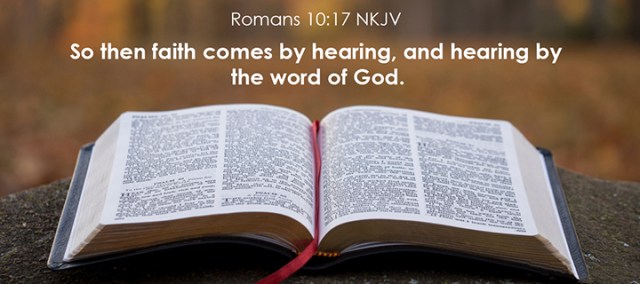
James described dynamic faith as true saving faith. To begin with, dynamic saving faith is based on the Word of God. We receive our spiritual rebirth through God’s Word (James 1:18). We receive the Word and it is this that saves us (James 1:21). “So then faith comes by hearing, and hearing by the word of God.” – Romans 10:17. James used Abraham and Rahab as illustrations of dynamic saving faith, since both of them heard and received the message of God through His Word.

et faith by hearing

Faith is only as good as its object. The man in the jungle bows before an idol of stone and trusts it to help him, but he receives no help. No matter how much faith a person may generate, if it is not directed at the right object, it will accomplish nothing. “I believe” may be the testimony of many sincere people, but the big question is, “In whom do you believe? What do you believe?” We are not saved by faith in faith; we are saved by faith IN Christ as revealed in His Word.

Dynamic faith is based on God’s Word, and it involves the whole man. Dead faith touches only the intellect; demonic faith involves both the mind and the emotions; but dynamic faith involves a person’s will as well. The whole person plays a part in true saving faith. The mind understands the truth; the heart desires the truth; and the will acts upon the truth. The men and women of faith named in Hebrews 11 were people of action: God spoke and they obeyed. Again, “Faith is not believing in spite of evidence before us; faith is obeying in spite of consequence that could be.”

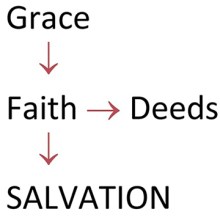
True saving faith leads to action. Dynamic faith is not intellectual contemplation or emotional consternation; it leads to obedience on the part of the will. And this obedience is not an isolated event: it continues throughout the whole life. It leads to works. As our title implies, Faith IS action IN action.

Many different kinds of works are named in the New Testament. “The works of the Law” (Galatians 2:16) relate to the sinner’s attempt to please God by obeying the Law of Moses. Of course, it is impossible for a sinner to be saved through the works of the Law. “The works of the flesh” (Galatians 5:19) are done by unsaved people who live for the things of the old nature. There are also “wicked works” (Colossians 1:21) and “dead works” (Hebrews 9:14). Where there is dynamic faith—saving faith—you will always find good works.

James then illustrated his doctrine in the lives of two well-known Bible persons: Abraham and Rahab. You could not find two more different people! Abraham was a Jew; Rahab was a Gentile. Abraham was a godly man, but Rahab was a sinful woman, a prostitute. Abraham was the friend of God, while Rahab belonged to the enemies of God. What did they have in common? Both of them exercised saving faith in God.

et counted righteous

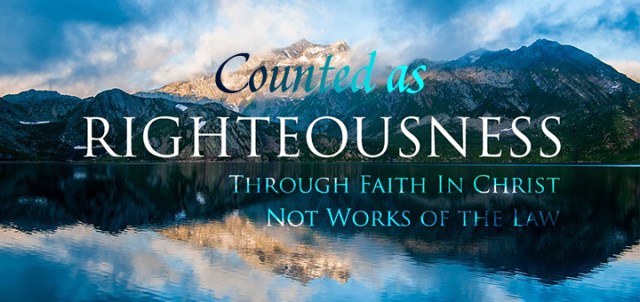
You will want to read Genesis 15 and 22 to get the background facts for this illustration of Abraham. God called Abraham out of Ur of the Chaldees to lead him into Canaan and to make out of him the great nation of Israel. It was through Israel that God would bring the Savior into the world. Abraham’s salvation experience is recorded in Genesis 15. At night, God showed His servant the stars and gave him a promise, “So shall your descendants be!” – verse 5. How did Abraham respond? “And he believed in the LORD, and He accounted it to him for righteousness.” – verse 6.

The word “counted” is a legal or financial term; it means “to put to one’s account.” As a sinner, Abraham’s spiritual bankbook was empty. He was bankrupt! But he trusted God, and God put righteous on Abraham’s account. Abraham did not work for this righteousness; he received it as a gift from God. He was declared righteous by faith. He was justified by faith (read Romans 4).

Justification is an important doctrine in the Bible. Justification is the act of God whereby He declares the believing sinner righteous on the basis of Christ’s finished work on the cross. It is not a process; it is an action on God’s part. It is not something the sinner does; it is something God does for the sinner when he trusts Christ. It is a once-for-all event. It never changes.

How can you tell if a person is justified by faith if this transaction takes place between the sinner and God privately? Abraham’s example answers that important question: the justified person has a changed life and obeys God’s will. His faith is demonstrated by his works.

James used another event in Abraham’s life, an event that took place many years after Abraham’s conversion. This event is the offering up of Isaac on the altar (Genesis 22). Abraham was not saved by obeying God’s difficult command. His obedience proved that he already was saved. “You see that his faith and his actions were working together, and his faith was made complete by what he did.” – James 2:22 (NIV). There is a perfect relationship between faith and works. As someone once expressed it, “Abraham was not saved by faith PLUS works, but by a faith THAT works.”

How was Abraham “justified by works” (James 2:21) when he had already been “justified by faith”? (again, see Romans 4). By faith, he was justified before God and his righteousness declared; by works he was justified before men and his righteousness demonstrated. It is true that no humans actually saw Abraham put his son on the altar, but the record in Genesis 22, inspired by the Holy Spirit, enables us to see the event and witness Abraham’s faith demonstrated by his works in full confidence that it did happen.

Next: Part Two

explore bible footer

Adaptation of excerpts from Warren W. Wiersbe, The Bible Exposition Commentary Volume 2.
Unless otherwise noted, Scripture taken from the New King James Version®, NKJV © 1982 by Thomas Nelson.
Where noted, Scripture taken from the Holy Bible, New International Version®, NIV © 2011 by Biblica, Inc.®
Used by permission. All rights reserved.
Scripture links provided by Biblia.com
Posted in Expository Teaching | Tagged , , , , , , , , , , , , , , , , , , , , , , , , , , , , , , , , , , , , , , , , , , , , | Leave a comment

Daily Prayer & Praise 9/22/2022

prayer and praise header 4
Prayer for Thursday

Lord our God, we lift our hearts to You, for You have given great promises to those who fear You and in awe of Your wonder. Let Your Word strengthen us in faith, patience, and hope. Be with all those who call upon You, sincerely, pleading for help in our time. For these times must work for our good, and in spite of sin, death, and all evil we can find joy in what You are accomplishing. We call to You, O Lord our God. Let Your hand be revealed in those things You are doing, that something may be seen besides the human striving and the efforts of human hands. Let the work of Your hand be visible to many, to people all over this earth. May Your name be honored, O Lord our God, may Your Kingdom come quickly, and may Your will be done on earth as it always is in Heaven. In Jesus’ name we seek You in all things.

Amen.

prayer footer 2

Adapted from the Daily Written Prayers of Christoph Friedrich Blumhardt, 1842–1919. In Public Domain
Posted in Prayer and Praise | Tagged , , , , , , , , , , , , , , , , , , , , , , , , , , , , , , , , , , , , , , , , , , , , , , | Leave a comment

The Evolution Theory

food for thought header 2
As taught in our public schools today, the Organic Theory of Evolution accounts for the origin of mankind as follows:

“Life on this planet originated several billion years ago, when electrical disturbances caused reactions to occur in the chemicals of the primeval ocean, and these reactions produced amino acids, and these amino acids organized themselves into living cells. As time went on, more chemical reactions caused the descendants of these one-celled organisms to mutate and develop into a variety of types of multi-celled plants and animals.

“The process continued, and as each new variety of organism appeared, natural selection would result in its being either better or less suited to the environment, and therefore it would either flourish or disappear. In the long run, then, species of plants and animals better and better suited to their respective environments appeared and developed.

“Man is the highest product of this development. He is immediately descended from the same ancestors as the apes; more remotely, from the same ancestors as all mammals. He is himself still developing; that process is stalled by our present lifestyle, but biologically it is inevitable.”

*Notice how evolution THEORY, no matter how foolish it is, is taught as fact!

Therefore God also gave them . . . who exchanged the truth of God for the lie, and worshiped and served the creature rather than the Creator, who is blessed forever. – Romans 1:24-25.

anecdotal story footer

*Pastor’s Note
Posted in Food For Thought | Tagged , , , , , , , , , , , , , , , , , , , , , , , , , , , , , , , , , , , , , | Leave a comment

The Missionary’s Master

thought of day header

Thursday September 22, 2022

John 13:13
“You call Me Teacher and Lord, and you say well, for so I am.”

To have a master and to be mastered is not the same thing. To have a master means that there is one who knows me better than I know myself, one who is closer than a friend, one who fathoms the remotest abyss of my heart and satisfies it, one who has brought me into the secure sense that he has met and solved every perplexity and problem of my mind. To have a master is this and nothing less—“One is your Master, even Christ.”

Our Lord never enforces obedience; He does not take means to make me do what He wants. At certain times I wish God would master me and make me do the thing, but He will not; in other moods I wish He would leave me alone, but He does not.

“Ye call me Master and Lord”—but is He? Master and Lord have little place in our vocabulary, we prefer the words Saviour, Sanctifier, Healer. The only word to describe mastership in experience is love, and we know very little about love as God reveals it. This is proved by the way we use the word obey. In the Bible obedience is based on the relationship of equals, that of a son with his father. Our Lord was not God’s servant, He was His son. “Though He were a Son, yet learned He obedience …” If our idea is that we are being mastered, it is a proof that we have no master; if that is our attitude to Jesus, we are far away from the relationship He wants. He wants us in the relationship in which He is easily Master without our conscious knowledge of it, all we know is that we are His to obey.

thought of the day footer 4

Oswald Chambers, My Utmost for His Highest: Selections for the Year (Oswald Chambers Publications; Marshall Pickering, 1986)
*Unless otherwise noted, Scripture taken from the New King James Version®, NKJV © 1982 by Thomas Nelson.
Used by permission. All rights reserved.
Posted in Daily Devotional | Tagged , , , , , , , , , , , , , , , , , , , , , , , , , , , , , , , , , , , , , , , , , , , | Leave a comment

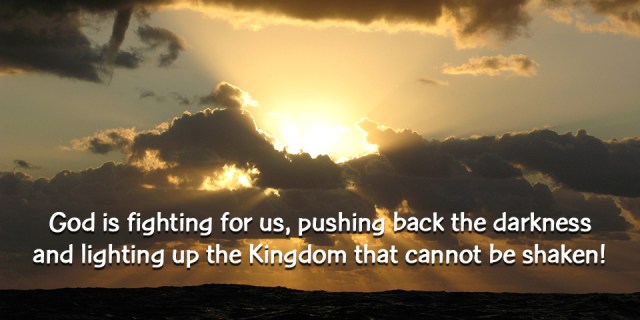
Lighting Up The Kingdom

nuff-said-header-2

ns 9-22 lighting up the kingdom

Posted in 'Nuff Said! | Tagged , , , , , , , , , , , , , , , , , , , , , , , , , , , , , , , , , , , , , , , | Leave a comment