Daily Prayer & Praise 1/11/2023

prayer and praise header 4
Wednesday Thanksgiving

Father, we thank you for being so ready to forgive us whenever we turn to you and honestly acknowledge your power and our own need. We praise you for the joy of knowing that no matter who we are or what we have done or failed to do, we can experience the joy of forgiveness and beginning again. Father, we thank you for the fellowship of your church, the community of those who have confessed their sin and are receiving your promise of life made whole. Thank you for every person who shares your love with us and for every person who demonstrates the reality of the love of Jesus in all they say and do; for every person whose offer of forgiveness has set us free to begin again and has been a sign to us of your love, which is always reaching out to us in Christ. We bring our thanks in the name of Christ, the true source of all thankfulness.

Amen.

prayer footer 2

David Clowes, 500 Prayers For All Occasions © 2003 by David C Cook Publishing
Used by permission. All rights reserved.
Posted in Prayer and Praise | Tagged , , , , , , , , , , , , , , , , , , , , , , , , , , , , , , , , , , , , , , | 1 Comment

God Makes All Things New – 2

expository teaching header 1

Scripture Text – Jeremiah 30-33

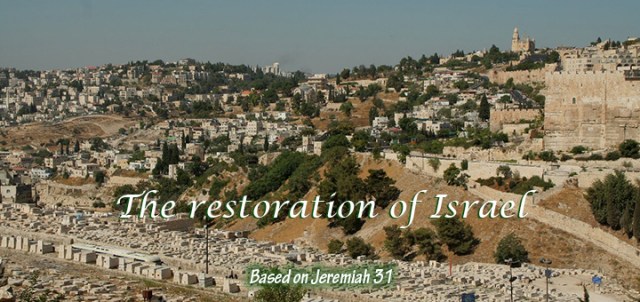
These chapters describe the glory of the dawning of a new day for the people of Israel, not only for the exiles in Babylon but also for the Jewish people in the latter days before the Lord returns. Jeremiah’s prophecy comprises both the near and far future.

Reconciliation: A New People

Please read Jeremiah 31:1-30 for the background to this section.
(Links will open in new window)

A nation is more than its land and cities; it’s people living together, working together, and worshiping together. Jeremiah describes the people of God and the new things the Lord would do for them. He first spoke about a united nation, then to Israel, and finally to Judah.

A united people (Jeremiah 31:1, 27-30). Because of the sins of Solomon and the foolishness of his son Rehoboam, the Jewish nation divided and became Israel and Judah, the Northern Kingdom and the Southern Kingdom (2 Kings 11–12). But in the last days, the Lord will gather His people, unite them, and be “the God of all the families of Israel.” In fact, God compared Israel and Judah to seed that will be sown in the land and produce one harvest, not two.

Jeremiah’s ministry included breaking down and plucking up as well as building and planting (Jeremiah 1:10); up to this point, it had been primarily the former. In the future, however, God will build and plant so the people and the land could be restored. There would be no more “blaming the fathers” for what happened (Ezekiel 18:1–4, 19–23; Deuteronomy 24:16), for each person will take responsibility for his or her own sins. This principle certainly had application to the remnant that returned to the land after the Captivity, for it was the failure of individuals to obey God that caused the ruin of the nation. If the kings and priests had been like Josiah and Jeremiah, the nation could have been saved.

A restored Israel (Jeremiah 31:2–20). The name “Ephraim” is a reference to the Northern Kingdom of Israel, whose capital was at Samaria. The people of the Northern Kingdom were captured in 722 B.C. by the Assyrians, who brought other peoples into the land so as to produce a mixed race (2 Kings 17). When the people of Judah returned to their land from the Captivity, they would have nothing to do with the Samaritans (Ezra 4:1–4; Nehemiah 2:19–20; 13:28), a practice that persisted into New Testament times (John 4:9). Subsequently, the Samaritans established their own religion, temple, and priesthood, and this alienated the Jews even more.

et israel restored

The promises recorded in this chapter don’t apply to Ephraim/Israel after the Captivity, because the Samaritans weren’t a part of the rebuilding of the land. These promises apply to the scattered Ten Tribes in the end times when God will call the Jews together and restore them to their land. Then there will be one nation, and the Samaritans will worship, not on Mt. Gerizim, but on Mt. Zion (see also John 4:20–24). Jeremiah pictured God summoning His family and gathering His flock, leading them out of the desert into the fruitful garden. Since none of this happened after the Captivity, we can assume it will occur in the end times when Ephraim repents and turns to the Lord. As you read these promises, notice the emphasis on singing, praise, and joy.

Matthew later referred to verses 15–17 (Matthew 2:16–18). Rachel was the mother of Joseph and Benjamin, and Joseph was the father of Ephraim and Manasseh, the two leading tribes in the Northern Kingdom (Genesis 30:22–24). Jeremiah heard Rachel weeping at Ramah, where the Jewish prisoners were assembled for their long journey to Babylon (Jeremiah 40:1). Her descendants through Joseph had been captured by the Assyrians, and now her descendants through Benjamin (the Southern Kingdom) were going to Babylon. Her labor as a mother had been in vain! (Remember, Rachel died giving birth to Benjamin.) But God assured her that both Ephraim and Judah will be restored, and therefore her sacrifices will not have been in vain.

A restored Judah (Jeremiah 31:21–26). On the way to Babylon, God instructed the Jews to remember the roads and set up markers along the route, for the people would use those same roads when they return to their land. Jeremiah pictured Judah as a silly girl, flitting from lover to lover, and now summoned home. (See Jeremiah 2:1–2, 20; 3:1–11.) According to the Law, a daughter who prostituted herself should have been killed (Leviticus 21:9; Deuteronomy 22:21), but God would do a new thing: He would welcome her home and forgive her!

The phrase “a woman shall compass a man” literally means “to surround with care, to shield”; it’s used of God’s care for Israel in the wilderness (Deuteronomy 32:10). The word used for “man” literally means “a strong man, a champion,” so the “new thing” God does is make the women so strong that they protect the men! (Keep in mind that this was a strongly masculine society.) In other words, their return won’t be a parade of weak stragglers; they will return like warriors, including the women, who were considered too weak in that day to fight. Picture Israel today and the women who take part in the military now!

This is a picture of that future regathering of the people of Israel in the end times. They will enjoy a renewed land, where the citizens will bless their neighbors in the name of the Lord.

To Be Continued

rightly dividing footer

Adaptation of excerpts from Warren W. Wiersbe, Be Decisive, “Be” Commentary Series.
Unless otherwise noted, Scripture taken from the New King James Version®, NKJV © 1982 by Thomas Nelson.
Used by permission. All rights reserved.
Posted in Expository Teaching | Tagged , , , , , , , , , , , , , , , , , , , , , , , , , , , , , , , , , , , , , , , , , , , | Leave a comment

Animal Cooperation

food for thought header 2
The animal inhabitant of the Pinna Marina is a blind slug or snail, which has many enemies, the worst of which is the cuttle-fish. No sooner does the pinna open his bivalve shell, than the cuttle-fish rushes in. How can such a blind defenseless creature secure food and protect himself?

Luckily there is a kind of crab-fish, with keen sight, who is a constant companion of the pinna. They live together in the shell that belongs to the pinna. When the latter is hungry, he opens his valves, and sends out his faithful companion to secure food. If any enemy approaches, the watchful crab dashes back to his blind protector, who quickly closes the valves as soon as his friend is inside.

On the other hand, when the crab has returned with food and no foe is about, he makes a gentle noise at the opening of the shell, which is closed during his absence. When admitted, the two friends then feast together on the fruits of the crab’s industry.

food for thought footer

Posted in Food For Thought | Tagged , , , , , , , , , , , , , , , , , , , , , , , , , , , , , , , , , , | Leave a comment

Paul’s Sermon Before Felix

thought of day header

Tuesday January 10, 2023

Acts 24:25
Now as he reasoned about righteousness, self-control, and the judgment to come,
Felix was afraid and answered, “Go away for now; when I have
a convenient time I will call for you.”

Felix, unhappy Felix! why is it that thou dost rise from thy judgment-seat? Is it that thou hast much business to do? Stop, Felix; let Paul speak to thee a minute longer. Thou hast business; but hast thou no business for thy soul? Stop, unhappy man! Art thou about again to be extortionate, again to make thy personal riches greater? Oh! stop: canst thou not spare another minute for thy poor soul? It is to live forever: hast thou nought laid up for it—no hope in heaven, no blood of Christ, no pardon of sin, no sanctifying Spirit, no imputed righteousness? Ah! man, there will be a time when the business that seems so important to thee will prove to have been but a day-dream, a poor substitute for the solid realities thou hast forgotten. Dost thou reply, “Nay, the king has sent me an urgent commission; I must attend to Caesar.” Ah! Felix, but thou has a greater monarch than Caesar, there is one who is Emperor of heaven and Lord of earth: canst thou spare no time to attend to his commands? Before his presence Caesar is but a worm. Man! wilt thou obey the one, and wilt thou despise the other? Ah! no; I know what thou durst not say. Felix, thou art turning aside again to indulge in thy lascivious pleasures. Go, and Drusilla with thee! But stop! Darest thou do that, with that last word ringing in thy ears, “Judgment to come?” What! Wilt thou repeat that wanton dalliance that hath damned thee already, and wilt thou go again to stain thy hands in lust, and doubly damn thy spirit, after warnings heard and felt? O man! I could weep o’er thee.

thought of the day footer 1

C. H. Spurgeon and Terence Peter Crosby, 365 Days with Spurgeon (Volume 1) (Day One Publications, 1998)
Unless otherwise noted, Scripture taken from the New King James Version®, NKJV © 1982 by Thomas Nelson.
Used by permission. All rights reserved.
Posted in Daily Devotional | Tagged , , , , , , , , , , , , , , , , , , , , , , , , , , , , , , , , , , , , , , , | Leave a comment

Reflecting With God 1/10/2023

reflecting with God header
Thinking, praying, reading, studying the Bible – when we do these things, we are reflecting on the Word of God. To reflect is to contemplate and/or consider, and God wants us to deeply reflect on His Word so that we can better understand Him.

Tuesday Reflecting

Trust in Him at all time, you people. – Psalm 62:8.

A parable says that there was a great king who employed his people to weave for him. The silk, and wool, and patterns were all given by the king, and he looked for diligent working people. He was very indulgent, and told them when any difficulty arose to send to him, and he would help them; and never to fear troubling him, but to ask for help and instruction. Among many men and women busy at their looms was one little child whom the king did not think too young to work. Often alone at her work, cheerfully and patiently she labored. One day, when the men and women were distressed at the sight of their failures—the silks were tangled, and the weaving unlike the pattern—they gathered round the child and said, “Tell us how it is that you are so happy in your work. We are always in difficulties.” “Then why do you not send to the king?” said the little weaver; “he told us that we might do so.” “So we do, night and morning.” “Ah,” said the child, “but I send as often as I have a little tangle.”
~ BEECHER

reflecting with God footer 2

Unless otherwise noted, Scripture taken from the New King James Version®, NKJV © 1982 by Thomas Nelson.
Used by permission. All rights reserved.
Posted in Reflecting With God | Tagged , , , , , , , , , , , , , , , , , , , , , , , , , , , , , , , , , , , , , | 2 Comments

Daily Prayer & Praise 1/10/2023

prayer and praise header 4
Tuesday Praise

Father, you are greater than anything we can imagine, more wonderful than our deepest joy, more powerful than anything we have known. Yours is the authority that always intended to create. Yours is the sovereignty that holds all things in the palm of your hand. Yours is the love that continually seeks to bring everyone, everywhere, into the joy of perfect fellowship with you. Father, we adore you; we have come to lay our lives before you, as we declare we love you, our God. Father, we praise you for the demonstration of your authority, sovereignty and love in the life, death and resurrection of your Son, Jesus Christ our Lord.

Amen.

prayer footer 2

David Clowes, 500 Prayers For All Occasions © 2003 by David C Cook Publishing
Used by permission. All rights reserved.
Posted in Prayer and Praise | Tagged , , , , , , , , , , , , , , , , , , , , , , , , , , , , , , , , , , , , , , | Leave a comment

God Makes All Things New – 1

expository teaching header 1

Scripture Text – Jeremiah 30-33

In these chapters, the Lord amplified the wonderful promise He gave to His people in the letter Jeremiah sent the Babylonian exiles:

“For I know the plans I have for you,” declares the Lord, “plans to prosper you and not to harm you, plans to give you hope and a future.” – Jeremiah 29:11 (NIV).

These chapters describe the glory of the dawning of a new day for the people of Israel, not only for the exiles in Babylon but also for the Jewish people in the latter days before the Lord returns. Jeremiah’s prophecy comprises both the near and far future.

Redemption: A New Beginning

Please read Jeremiah 30:1-24 for the background to this section.
(Links will open in new window)

Jeremiah received the words recorded in 30:1–31:25 while he was asleep, for God sometimes spoke to His servants through dreams (Daniel 10:9; Zechariah 4:1). God instructed Jeremiah to write His words down so the nation would have a permanent record of the promises God was giving to His people (Jeremiah 36:1–4).

In His instructions to Jeremiah, God stated the theme of His message: Israel (the Northern Kingdom) and Judah (the Southern Kingdom) will eventually return to their land as a united people. While this promise refers ultimately to the regathering of the Jews at the end of the age, it certainly was an encouragement to the exiles in Babylon, for if God can gather His people from all the nations of the world, surely He can deliver Judah from the captivity of one nation. Note God’s promise in verse 10.

This “redemption” of His people from bondage is pictured in several ways.

The broken yoke (Jeremiah 30:4-11). “For it shall come to pass in that day . . . that I will break his yoke from your neck, and will burst your bonds; foreigners shall no more enslave them.” When the prophets used the phrase “in that day,” they were usually referring to the future time when God will judge the nations of the world and restore the Jews to their land.

Before Israel is delivered, however, all the nations of the earth will experience “the time of Jacob’s trouble,” a phrase that describes the time of tribulation that will come upon the earth (Matthew 24:21–31; Mark 13:19–27; Revelation 6–19). A frequent biblical symbol of suffering is that of a woman in travail, and this image is used to describe the Tribulation in the end times (see Isaiah 13:8; Micah 4:9–13; 1 Thessalonians 5:1–3).

et coming king

The promise in verse 9 applies to the future Kingdom Age, following the Tribulation, when the Messiah shall reign over His people. You find corresponding promises in Jeremiah 23:5 and 33:14–26. When Jesus was here on earth, His people said, “We will not have this man to reign over us.” – Luke 19:14. However, in that day, they will recognize their Messiah-King and welcome Him (Zechariah 12:8–14:21).

The healed wound (Jeremiah 30:12-17). In Isaiah’s day, Judah was a “sick” nation (Isaiah 1:5–6), and thanks to the superficial ministry of the false prophets (Jeremiah 6:14; 8:11), the sickness became worse in Jeremiah’s day (Jeremiah 10:19; 14:17; 15:18). The Lord reminded the Jews that it was He who used other nations to discipline them because of their disobedience to Him. He used Assyria to chasten Israel and Babylon to punish Judah, and in the latter days, He will use the Gentile nations to correct Israel and prepare the Jews for the return of their Messiah. However, God will punish the Gentile nations for the way they treat Israel in the last days (see Joel 3) just as He punished Assyria and Babylon. “For I will restore health to you And heal you of your wounds,” was God’s encouraging promise.

The calm after the storm (Jeremiah 30:18–24). Jeremiah then picked up the image of the storm that he had used earlier (see Jeremiah 23:19–20) to describe the Babylonian assault, but now he related it to the trials of “the latter days.” God promised that Jerusalem and the cities of Judah will be rebuilt and that the fortunes of the people will be restored. Their mourning will turn to joy and their children will again enjoy a normal life.

Instead of being under despotic Gentile rulers, the Jews will have the Messiah as their ruler, “from among them,” that is, a Jew. But here’s a surprising revelation: Not only will the Messiah be their King, but He will also be their Priest! “Then I will cause him to draw near, and He shall approach Me.” This is language that applies especially to the Jewish high priest, who alone entered the holy of holies on the annual Day of Atonement (Leviticus 16). Only Jesus Christ, who is both King and Priest (Hebrews 7–8), can qualify to fulfill this prophecy.

So, to sum it up: The people of Judah and Jerusalem will experience terrible trials at the hands of the Babylonians. They will end up wearing the Gentile yoke, bearing the wounds caused by their sins, and having endured the storm of God’s wrath. But God would eventually deliver them, breaking the yoke, healing the wounds, and bringing peace after the storm. All of this will be a foreshadowing of what will happen to the Jews in the end times as they go through the Tribulation, meet their Messiah-King, and enter into their kingdom.

To Be Continued

rightly dividing footer

Adaptation of excerpts from Warren W. Wiersbe, Be Decisive, “Be” Commentary Series.
Unless otherwise noted, Scripture taken from the New King James Version®, NKJV © 1982 by Thomas Nelson.
Where noted, Scripture taken from the Holy Bible, New International Version®, NIV © 2011 by Biblica, Inc.
Used by permission. All rights reserved.
Posted in Expository Teaching | Tagged , , , , , , , , , , , , , , , , , , , , , , , , , , , , , , , , , , , , , , , , , , , , , | Leave a comment

Buddy, Buddy Among Creatures

food for thought header 2
On top of the Spanish Pyrenees may be found a magnificently beautiful but elusive mountain goat. It seems always to get away from shooting range. Why? It has a companion, a young goat, who follows and sounds the warning of enemies around it.

The rhinoceros has very poor eyesight. But its tough hide is infested with ticks—a delicacy to a certain little bird which rides on its back, feeding on the insects and alerting the rhino to danger.

Both the ratel, a badger-like animal, and the little honey-guide bird love honey. And so they go out together. The keen eye of the little bird quickly pin-points a beehive with honey, and the ratel’s powerful claws tear up the hive, making the honey available to both.

food for thought footer

Posted in Food For Thought | Tagged , , , , , , , , , , , , , , , , , , , , , , , , , , , , , , , , , , | Leave a comment

Seeking For More of God

thought of day header

Monday January 9, 2023

Exodus 33:18
And he said, “Please, show me Your glory.”

When Moses saw the glory of God he begged that he might see more. When God revealed to him that he had found grace, he wanted more grace. Remember this: The man that has the most of God is the man who is seeking the most ardently for more of God. . . .

I have been greatly and deeply concerned that you and I do something more than listen, that we dare to go to God like the Lady Julian and dare to ask Him to give us a faithful, fatherly wound—maybe three of them, if you please: to wound us with a sense of our own sinful unworthiness that we’ll never quite get over; to wound us with the sufferings of the world and the sorrows of the Church; and then to wound us with the longing after God, a thirst, a sacred thirst and longing that will carry us on toward perfection. . . .

Almost every day of my life I am praying that “a jubilant pining and longing for God” might come back on the evangelical churches. We don’t need to have our doctrine straightened out; we’re as orthodox as the Pharisees of old. But this longing for God that brings spiritual torrents and whirlwinds of seeking and self-denial—this is almost gone from our midst.

thought of the day footer 2

Tozer on the Almighty God : A 366-Day Devotional (WingSpread, 2004)
Unless otherwise noted, Scripture taken from the New King James Version®, NKJV © 1982 by Thomas Nelson.
Used by permission. All rights reserved.
Posted in Daily Devotional | Tagged , , , , , , , , , , , , , , , , , , , , , , , , , , , , , , , , , , , , , , , | Leave a comment

Reflecting With God 1/09/2023

reflecting with God header
Thinking, praying, reading, studying the Bible – when we do these things, we are reflecting on the Word of God. To reflect is to contemplate and/or consider, and God wants us to deeply reflect on His Word so that we can better understand Him.

Monday Reflecting

For You have been a shelter for me. – Psalm 69:3.

Somewhere in the East, there is said to be a tree which is a non-conductor of electricity. The people know it; and, when a storm comes, they flee toward it for safety. Beautiful picture of the Saviour!—beautiful emblem of the tree on Calvary! It is a non-conductor of wrath.
~ THOMAS JONES

reflecting with God footer 2

Unless otherwise noted, Scripture taken from the New King James Version®, NKJV © 1982 by Thomas Nelson.
Used by permission. All rights reserved.
Posted in Reflecting With God | Tagged , , , , , , , , , , , , , , , , , , , , , , , , , , , , , , , , , , , , , | Leave a comment

Daily Prayer & Praise 1/09/2023

prayer and praise header 4
Monday Preparation

Father, we come with our emptiness and our times of defeat. We come with our excuses,
with our readiness to blame anyone but ourselves. We come to you acknowledging who and what we are. We come to confess that you are the one who can make us whole. We come to you because we have nowhere else and no one else to come to. Father, we have come to praise you for inviting us to come.

Amen.

prayer footer 2

David Clowes, 500 Prayers For All Occasions © 2003 by David C Cook Publishing
Used by permission. All rights reserved.
Posted in Prayer and Praise | Tagged , , , , , , , , , , , , , , , , , , , , , , , , , , , , , , , , , , , , , , | Leave a comment

Christ In The Midst of The Church – 3

pastor's desk header

Pastor’s Note: We’re continuing on from where we left off the week before Christmas. If you want to review, here is the link: Christ In The Midst of The Church – 2

Christ Jesus in our midst is the key to joyfulness.

When Jesus walked into the locked upper room where the disciples were meeting, He greeted them with “Peace be with you,” a peace that only He could give! “When He had said this, He showed them His hands and His side. Then the disciples were glad when they saw the Lord.” – John 20:20. They were glad, they were filled with joy; here is a whole new dimension in the Christian life!

Small wonder these disciples were glad. Jesus had walked into death, entered into Sheol, and emerged again with the keys of death and hell in His hands, having conquered the grave by His resurrection. Reflecting on this tremendous event, John wrote later on, “You are of God, little children, and have overcome them (every contrary spirit to God), because He who is in you is greater than he who is in the world.” – 1 John 4:4.

There is a story of Billy Graham, who once visited our troops while they were fighting in Korea. Around 5:00 A.M. he was awakened to go to a prayer and praise service. They arrived at the place where the little church was assembled. It was twenty degrees below zero; the bitter wind made it feel still colder. The front and back walls had been blown out of the church. Two side walls remained, with no roof or heat. The people were on their knees praying. Billy Graham could not understand what they saying, so he asked someone to translate. The translator responded, “They are all praying the same prayer: ‘Thank you, Jesus!'”

Jesus used the phrase, “Be of good cheer,” often times when speaking with the disciples. He spoke of forgiveness, “Be of good cheer; your sins are forgiven you.” – Matthew 9:2. He spoke of peace and companionship, “Be of good cheer! It is I; do not be afraid.” – Matthew 14:27. And He spoke of victory, “Be of good cheer, I have overcome the world.” – John 16:33.

These expressions cover the totality of a Christian’s life – past, present, and future. The sin of the past is blotted out for the believing Christian. The continual fellowship of Christ is offered for the present. And the future will reveal Christ as the Conqueror and Sovereign King of the world. This is possible because Jesus is in the midst of the believer’s life, His Body, His Church, bringing joy!

TO BE CONTINUED

pastor's desk footer

Unless otherwise noted, Scripture taken from the New King James Version®, NKJV © 1982 by Thomas Nelson.
Used by permission. All rights reserved.
Posted in Pastor's Desk | Tagged , , , , , , , , , , , , , , , , , , , , , , , , , , , , , , , , , , , , | 2 Comments

The New Life

classic poetry header
*Pastor’s Note: A.B. Simpson was a very well respected Canadian preacher, theologian and author who lived from December 15, 1843 to October 29, 1919. My prayer is that you will be blessed and inspired by his poetry as much as I am.


THE NEW LIFE

cp the new life

Life’s crisis has been passed,
And I have come at last
Into the Promised Land of Peace and Rest;
The crisis hour is o’er
And now forevermore
I’m dwelling in God’s blessing and God’s best.

It came, I know not how,
But this I know, that now
My life has found a new and nobler plane;
Something has passed away,
Something has come to stay,
And I can never be the same again.

The change is not in me,
Rather, it seems that He
Has come Himself to live His life in mine;
And as I stepped aside
And took Him to abide,
He came and filled me with His life divine.

cp the new life

I came to Jordan’s flood,
And as with Him I stood,
The Heavenly Dove upon my spirit came;
Just how I cannot tell,
But this I know full well
That life henceforth can never mean the same.

And yet it brings no strain,
But hand, and heart, and brain
Move on with all the old simplicity;
I do not have to try
For it is no more I
But Christ who thinks, and lives, and moves in me.

The testing hours have come,
In flesh, and heart, and home,
But He was near my every load to share.
New tasks have called me on,
New victories have been won,
But through the cloud and sunshine He was there.

cp the new life

No more I doubt or fear,
The way shines bright and clear,
And One who ne’er can fail is leading on;
He will not let me stray
But lead me all the way
Until the fight is fought, the crown is won.

classic poetry footer

From Songs of the Spirit: Poetry by A. B. Simpson. Public Domain
Posted in Classic Poetry | Tagged , , , , , , , , , , , , , , , , , , , , , , , , , , , , , , , , , | Leave a comment

Centuries of Meditations – First Century 31-32

devotionals header

31

Yet further, you never enjoy the world aright, till you so love the beauty of enjoying it, that you are covetous and earnest to persuade others to enjoy it. And so perfectly hate the abominable corruption of men in despising it, that you had rather suffer the flames of Hell than willingly be guilty of their error. There is so much blindness and ingratitude and damned folly in it. The world is a mirror of infinite beauty, yet no man sees it. It is a Temple of Majesty, yet no man regards it. It is a region of Light and Peace, did not men disquiet it. It is the Paradise of God. It is more to man since he is fallen than it was before. It is the place of Angels and the Gate of Heaven. When Jacob waked out of his dream, he said “God is here, and I wist it not. How dreadful is this place! This is none other than the House of God, and the Gate of Heaven.”

32

Can any ingratitude be more damned than that which is fed by benefits? Or folly greater than that which bereaveth us of infinite treasures? They despise them merely because they have them: And invent ways to make themselves miserable in the presence of riches. They study a thousand newfangled treasures, which God never made: and then grieve and repine that they be not happy. They dote on their own works, and neglect God’s, which are full of majesty, riches, and wisdom. And having fled away from them because they are solid, divine and true, greedily pursuing tinseled vanities, they walk on in darkness, and will not understand. They do the works of darkness, and delight in the riches of the Prince of Darkness, and follow them till they come into Eternal Darkness. According to that of the psalmist All the foundations of the Earth are out of course.


Thomas Traherne (1637 – September 27, 1674) was an English poet, Anglican cleric, theologian, and religious writer. Traherne’s writings frequently explore the glory of creation and what he saw as his intimate relationship with God. His writing conveys an ardent, almost childlike love of God, and is compared to similar themes in the works of later poets William Blake, Walt Whitman, and Gerard Manley Hopkins. His love for the natural world is frequently expressed in his works.

The work for which Traherne is best known today is the Centuries of Meditations, a collection of short paragraphs in which he reflects on Christian life and ministry, philosophy, happiness, desire and childhood. This was first published in 1908 after having been rediscovered in manuscript ten years earlier. Before its rediscovery this manuscript was said to have been lost for almost two hundred years and is now considered a much loved devotional.

devotionals footer 2

Thomas Traherne, Centuries of Meditations. Public Domain
Posted in Classic Devotionals | Tagged , , , , , , , , , , , , , , , , , , , , , , , , , , , , , , , , , | Leave a comment

Gideon, An Unlikely Hero – 11

great sermons header

gs - c.h. mackintosh

Charles Henry Mackintosh (October 1820 – November 2, 1896) was a nineteenth-century Christian preacher, dispensationalist, writer of Bible commentaries, magazine editor and member of the Plymouth Brethren. In 1843, Mackintosh wrote his first tract entitled Peace with God. When he was 24, he opened a private school where he developed a special method of teaching classical languages. Mackintosh went around preaching the gospel to the poor during school holidays. He wrote to John Nelson Darby on August 31, 1853 that the Lord had “called me into larger service than ever,” and he soon concluded that he must give himself entirely to preaching, writing, and public speaking.

Gideon, An Unlikely Hero Part 11

We are now to contemplate Gideon called forth into action. He has received his commission from Jehovah. His questions have been answered, his fears hushed, his heart tranquilized, and he is enabled to build an altar. All this had reference to his own personal condition, to the state of his own soul, to the attitude of his own heart as in the sight of God.

Thus it must ever be. We must all begin in this way, if we are ever to be used of God to act on others. We must have to do with God in the secret of our own souls, else we shall prove to be but sorry workmen in the sequel. All who go forth in public work without this secret training, are sure to prove flimsy and shallow. Self must be measured in the divine presence. We must learn that nature is of no account in the Lord’s work. “Not by might, nor by power, but by My Spirit, saith the Lord of hosts.” – Zechariah 4:6.

It was not until Gideon had gone through somewhat of this holy discipline in secret that he was led out into service. And let us carefully note where he had to commence. “It came to pass the same night, that the Lord said unto him, Take thy father’s young bullock, even the second bullock, of seven years old,” for Jehovah knew how many bullocks Joash had and the age of each, “and throw down the altar of Baal that thy father hath, and cut down the grove that is by it. And build an altar unto the Lord thy God upon the top of this rock, in the ordered place, and take the second bullock, and offer a burnt sacrifice with the wood of the grove which thou shalt cut down.”

Here we see that Gideon had to begin at home. He was called to unfurl the standard of testimony in the very bosom of his family, in the very center of his father’s house. This is intensely interesting, and deeply practical. It teaches a lesson to which we should all bend our ears and apply our hearts. Testimony must begin at home. It will never do to rush forth into public work while our private and domestic ways are anything but what they ought to be. It is useless to set about throwing down the altar of Baal in public, while the selfsame altar remains standing at home.

This is of the very first importance. We are all of us imperatively called upon to show piety at home. Nothing is more sorrowful than to meet with persons who, abroad amongst their fellow men or their fellow Christians, are marked by a high tone of spirituality, a style of speaking which would lead one to suppose them far beyond the ordinary level of Christians, and yet when you come to close quarters with them, when you become acquainted with their private life and ways, their actual history from day to day, you find them very far indeed from bearing testimony for Christ to those with whom they come in contact. It dishonors the Lord Jesus, grieves the Spirit, stumbles and repulses young believers, gives occasion to the enemy to speak reproachfully, and to our brethren to speak doubtfully of us.

There ought to be a testimony yielded at home. Those who see most of us should see most of Christ in us. Those who know us best ought best to know that we are Christ’s. But alas! How often is it otherwise! How often the home circle is just the place where the lovely traits of Christian character are least exhibited! The wife or the husband, the parent or the child, the brother or the sister, the master or the servant, the fellow-servant or some other companion in daily life, is just the one in whose sight we least display the beautiful fruits of divine life. It is in private life that all our weak points come out, our oddities and peculiarities, our silly tendencies and sinful tempers: instead, it ought to be in that very sphere that the grace of Jesus is most faithfully manifested.

Christian reader, let us not turn away from the word of reproof, of admonition, or exhortation. It may not be pleasant; but, we may rest assured, it is profitable. It may not be agreeable to the flesh; but it is wholesome to the soul. We are called, like Gideon, to begin at home, if we would prove helpful to our brethren, or act effectively against the common foe.

To Be Continued

gs gideon unlikely hero

Minor adaptation of excerpts from C. H Mackintosh, Gideon and His Companions. Public Domain.
Unless otherwise noted, Scripture taken from The Holy Bible: King James Version (KJV) Public Domain.

Posted in Great Sermons From The Past | Tagged , , , , , , , , , , , , , , , , , , , , , , , , , , , , , , , , , , , , | Leave a comment

Verses or Chapter?

thought of day header

For Saturday January 7, 2023

Psalm 119:11
Your word I have hidden in my heart.

Michael Billester visited eastern Poland during the late 1930s and gave a Bible to one of the villagers while there. The villager read it, was converted, and passed the book to two hundred others, who were all saved by reading it. When Billester returned in 1940, the group gathered for a worship service, and he suggested they all recite a few Bible verses they had memorized. A man stood up and said, “Perhaps we have misunderstood. Did you mean verses or chapters?” Billester was astonished to learn that the people had memorized whole chapters of the Bible. In fact, together, the two hundred villagers knew almost the entire Bible by heart.

We need to view committing Scripture to memory to be as important as the Polish villagers did. Value its power and effectiveness in our lives as much as Jesus did when He used it to defend Himself against Satan’s temptations.

Remember the true purpose for memorizing Scripture—“that you may be able to stand against the wiles of the devil” (Ephesians 6:11)—and make it a priority to spend some time etching the Word of God into your heart and mind.

Nobody ever outgrows Scripture; the Book widens and deepens with our years.
C. H. SPURGEON

thought of the day footer 6

David Jeremiah, Turning Points with God: 365 Daily Devotions (Tyndale, 2014)
Unless otherwise noted, Scripture taken from the New King James Version®, NKJV © 1982 by Thomas Nelson.
Used by permission. All rights reserved.
Posted in Daily Devotional | Tagged , , , , , , , , , , , , , , , , , , , , , , , , , , , , , , , , , , , , , , , , , | Leave a comment

The Blessing of The Sabbath

life in focus header

THE commandment to keep the Sabbath holy (Deuteronomy 5:12) did not mean that the other days of the week and their activities were unholy. The Sabbath was to remind Israel that human beings were dependent on God, and that they have strong tendencies to exalt themselves and their accomplishments, to turn them into gods even—to borrow an OT expression. In today’s terms, we might say that our pursuits become addictions. The Sabbath enforced a day of rest and worship in the weekly cycle to keep their focus on the Lord rather than on themselves and their accomplishments. Sunday, as the Lord’s Day, can help Christians set boundaries on who and what we worship and make the god of our lives.

life in focus footer

Courtesy of Nelson’s New Illustrated Bible Commentary
Unless otherwise noted, Scripture taken from the New King James Version®, NKJV © 1982 by Thomas Nelson.
Used by permission. All rights reserved.
Posted in Life In Focus | Tagged , , , , , , , , , , , , , , , , , , , , , , , , , , , , , , , , , , | Leave a comment

How Did They Live?

anecdotal stories

Since then, no prophet has risen in Israel like Moses, whom the LORD knew face to face, who did all those signs and wonders the LORD sent him to do in Egypt—to Pharaoh and to all his officials and to his whole land. For no one has ever shown the mighty power or performed the awesome deeds that Moses did in the sight of all Israel. – Deuteronomy 34:10-12.

Therefore, since we are surrounded by such a great cloud of witnesses, let us throw off everything that hinders and the sin that so easily entangles. And let us run with perseverance the race marked out for us, – Hebrews 12:1.

Scholars beamed as they examined the faded pen strokes on the ledgers before them. The invaluable books belonged to George Washington and came to light when other Washington family treasures were found in a Washington and Lee University vault. The find, which vastly enriched the already bulging store of Washington memorabilia, proved that Martha Custis brought enormous wealth to the marriage: 26,650 pounds, or nearly six million dollars. The thirty-six page document from the General’s account book details both his settlement of the Custis estate and his guardianship of the stepchildren.

The ordinary person has an inveterate curiosity about the everyday life of the famous. Perhaps we wish to share vicariously in the riches and influence that are beyond us personally. Christians elevate this curiosity to a higher level. Living in a secular world and seeing unacceptable models of behavior, we seek a spiritual model. In Scripture famous spiritual heroes march in unbroken ranks before us. Desiring most intensely to please God, we search his Word to see how people have pleased him in the past. Their example helps us to please him now.

anecdotal story footer 3

Courtesy of Speaker’s Sourcebook of New Illustrations by Virgil Hurley © 1995 by Word, Incorporated.
Unless otherwise noted, Scripture taken from the Holy Bible, New International Version®, NIV © 2011 by Biblica, Inc.®
Used by permission. All rights reserved.
Posted in Anecdotal Stories | Tagged , , , , , , , , , , , , , , , , , , , , , , , , , , | Leave a comment

Piercing Heaven 1/07/2023

prayer and praise header 3
Philip Doddridge Prayer

Our Father, you are seated on a throne of glory in the highest heaven, and we bow before your awful presence with humble reverence. Even so we approach you with the confidence that we are your children, and you are our bountiful and compassionate parent.

We join our prayers to you with hearts full of brotherly love, and ask for each other the blessings we seek for ourselves.

Above all, we desire your glory. May your name be set apart and holy. May the whole world of living creatures join us to give you the honor you so deserve and require. May your kingdom come and your will be done among us. Help us to know, understand, and pursue your kingdom.

And may your will, always wise and gracious, be done on earth just as it is in heaven. Teach us mortals to resign ourselves to you in obedience, the same way your angels in heaven obey you.

As for ourselves, Lord, help us not to seek the grand things of life. Help us not to worry about the future, but we humbly ask that you would open your bountiful hand—the one on which we always depend. Give us our daily supply for what we need today, and teach us to let you take care of the rest.

Though in many respects we have been disobedient and ungrateful children, yet we beg you, compassionate Father, to forgive us our offenses. We know we are guilty in your book, with debts we can never repay. But please forgive those debts, even as we forgive others—even those who have offended and injured us. We ask for the same kind of pardon we are willing to extend to others.

And do not bring us into places of pressing temptation, where we would lose our integrity and our soul would be endangered. But if we must be tried, graciously rescue us from the power of the evil one, that he would not triumph.

We know you can do these things for your children, and we humbly trust you will, because yours is the universal kingdom, the fullness of almighty power, and the glory of infinite perfection. To you be the praise of all, forever.

Amen. So may it be. We sincerely and earnestly desire that you may be glorified and our prayers heard and accepted.

Amen.

puritan prayers footer

Posted in Prayer and Praise | Tagged , , , , , , , , , , , , , , , , , , , , , , , , , , , , , , , , , , , , , , | Leave a comment

Peace With God

pastor's desk header

Therefore, having been justified by faith, we have peace with God through our Lord Jesus Christ. – Romans 5:1.

The Apostle Paul writes that as unbelievers, unsaved, we were enemies with God. “Having now been justified by His blood, we shall be saved from wrath through Him. For if when we were enemies we were reconciled to God through the death of His Son, much more, having been reconciled, we shall be saved by His life.” – Romans 5:9-10. Then in Romans 8:7-8, “Because the carnal mind is enmity against God; for it is not subject to the law of God, nor indeed can be. So then, those who are in the flesh cannot please God.”

Therefore we can surmise that we are enemies, not because God wants to be an enemy, but since we can’t obey God’s Law, or fulfill God’s will and God is absolutely and wholly just, pure and holy, we can’t begin to be “friends” with Him in that condition. The prophet Isaiah wrote in a couple of areas about that predicament that the carnal man is trapped in:

  • “There is no peace,” says the LORD, “for the wicked.” – Isaiah 48:22.
  • “The work of righteousness will be peace, And the effect of righteousness, quietness and assurance forever.” – Isaiah 32:17.

We need to understand where we stand from God’s perspective. Condemnation means that God declares us sinners, which is a declaration of war. Justification means that God declares us righteous, which is a declaration of peace, made possible by Christ’s death on the cross.

“Mercy and truth have met together; righteousness and peace have kissed.” – Psalm 85:10. We need to fully understand that, “because the law brings about wrath” (Romans 4:15), nobody condemned by the Law can enjoy peace with God. But when you are justified by faith, you are declared righteous, and the Law cannot condemn you and God no longer declares war!

As you can see, our justification is not simply a guarantee of heaven, as thrilling and as great as that is by itself, but it is also the source of tremendous blessings that we enjoy here and now. The added blessing is that our justification is a lasting thing. When God declared us righteous in Jesus Christ, He gave to us spiritual blessings that assure us that we will always have fellowship with Him and that peace, which is only one of the great blessings, will always be ours in Christ Jesus.

This week I’ve spent some time teaching about peace. The world we live in right now is in such turmoil that if a person, especially a believer gets there eyes off Jesus Christ and loses focus, it can be overwhelming with the blatant wickedness and corruption around us. But we have a promise that no enemy, whether from the world or the spiritual darkness can ever take from us:

“Peace I leave with you, My peace I give to you; not as the world gives do I give to you. Let not your heart be troubled, neither let it be afraid.” – John 14:27.

What better promise, what better gift to enter into this New Year with then a promise as sure and as steadfast as this one?

If you are a believer, if you have been justified, then God is no longer at war with you but is available with just the peace you need. If you’re not a believer just yet, why not get in touch with someone who will share with you the joys of just that type of peace with God; the kind of peace that only God can offer!

pastor's desk footer

Unless otherwise noted, Scripture taken from the New King James Version®, NKJV © 1982 by Thomas Nelson.
Used by permission. All rights reserved.
Posted in Pastor's Desk | Tagged , , , , , , , , , , , , , , , , , , , , , , , , , , , , , , , , , , , , , | Leave a comment