Daily Prayer & Praise 2/08/2023

prayer and praise header 4
Lord, hear our prayer:

Father, we thank you for all who have acted with courage to set people free from injustice, oppression and all that spoils life. We praise you that through the Spirit of Christ we can be free to worship you in truth, to serve you in love and to witness to your praise and glory. Lord, may our words and our thoughts and our lives enable others to enter your freedom in Christ. We bring our thanks in the name of Christ, the true source of all our liberty.

Amen.

prayer footer 2

Some minor adaptation on some prayers.
David Clowes, 500 Prayers For All Occasions © 2003 by David C Cook Publishing
Used by permission. All rights reserved.
Posted in Prayer and Praise | Tagged , , , , , , , , , , , , , , , , , , , , , , , , , , , , , , , , , , , , , , | Leave a comment

Psalm 119 – Beth

expository teaching header 1

Scripture Text – Psalm 119

The emphasis in this the longest psalm, and the basic theme, is on the vital ministry and practical use of the Word of God in the inner spiritual life of God’s children. It describes how the Word enables us to grow in holiness and handle the persecutions and pressures that always accompany an obedient walk of faith.

The Word of God performs many wonderful ministries in the life of the devoted believer. If we delight in His Word, learn it, treasure it within, and obey what it says, the Lord will work in us and through us to accomplish great things for His glory! Circumstances may change, but God and His Word remain the same.

Beth – Take Time To Be Holy

Please read Psalm 119:9-16 for the background to this section.

The writer closed the first section determined to keep the law of the Lord, a promise he repeated in verse 145. He began this section like a true Jewish teacher by asking a question of the young men he was instructing: “How can a young man cleanse his way?” He also promised to meditate on the Word, to delight in the Word and not forget it, and to run in the way of the Lord. But he knew that it is easier to make promises than to keep them, a lesson Paul learned when he tried in his own strength to obey God’s law (Romans 7:14–25). Paul learned, as we must also learn, that the indwelling Holy Spirit enables the child of God to fulfill God’s righteousness in daily life (Romans 8:1–11). We must live according to God’s Word, which means cultivating a heart for God. Paul stated we can accomplish this when we “seek those things which are above, where Christ is.” – Colossians 3:1.

et seek things above

We need a heart that seeks God, for if our heart is seeking God, our feet will not stray from God (see Proverbs 4:23). Such a heart will see Him in all of life, learn more about Him, fellowship with Him, and glorify Him in all that is said and done. Again, the Holy Spirit enables us to do this as we yield to Him. But we must also spend time in the Word and treasure it in our hearts (see also Job 23:12; Proverbs 2:1; 7:1). It is not our promises to the Lord but His promises to us that will give us victory over sin. We also need a thankful heart and a teachable spirit that will enable us to learn from the Lord. A. W. Tozer used to warn against being “man taught” instead of “God taught.” The Lord has given teachers to His church and we should heed them. But unless the truth we hear moves from the head (and the notebook) into the heart, written there by the Spirit (2 Corinthians 3:1–3), and then to the will, we have not really learned the Word or been blessed by it. The blessing comes, not in hearing the Word but in doing it (James 1:22–25). We should also speak with others about the Word and seek to enrich them with spiritual treasures. The heart is a treasury from which we draw spiritual wealth to encourage and help ourselves and others (Matthew 12:35; 13:51–52). The Scriptures as riches is a repeated theme in 119 (and see Psalm 19:10). To treasure any possession above the Word of God is idolatry and leads to trouble. Consider Lot (Genesis 13, 18–19), Achan (Joshua 6–7), King Saul (1 Samuel 15), and Ananias and Sapphira (Acts 5). On the positive side, consider Abraham (Genesis 14:18–24), Moses (Hebrews 11:24–27), Mary of Bethany (Mark 14:3–9), and Paul (Philippians 3:1–11).

Whatever delights will capture our attention and we will think about it and meditate on it. This is true of God’s Word. In this psalm, delighting in the Word, loving the Word, and meditating on the Word are found together, and they should be found together in our hearts and lives. We must take time to be holy. Remember, the Lord commands it, “Be holy, for I am holy.” – 1 Peter 1:16; Leviticus 11:44.

To Be Continued

rightly dividing footer

Adapted and modified excerpts from Warren W. Wiersbe, Be Exultant, “Be” Commentary Series.
Unless otherwise noted, Scripture taken from the New King James Version®, NKJV © 1982 by Thomas Nelson.
Used by permission. All rights reserved.
Posted in Expository Teaching | Tagged , , , , , , , , , , , , , , , , , , , , , , , , , , , , , , , , , , , , , , , , , , , , , , , , , , | Leave a comment

Food For Thought 2/07/2023

food for thought header 2

What Did Booth Leave?

A question sent in to The Canadian Magazine read: “Did General William Booth, founder of the Salvation Army, leave a large estate when he died?”

The answer: “Booth died in 1912 in London, England, at the age of 83, leaving some property worth about $1,200 at today’s exchange rate. Another $13,250 given him in trust by an influential friend, he left to his eight children.”

food for thought footer

Posted in Food For Thought | Tagged , , , , , , , , , , , , , , , , , , , , , , , , , , , , , , , , , , , | Leave a comment

The Prodigal’s Return

thought of day header

Tuesday February 7, 2023

Luke 15:20
“But when he was still a great way off, his father saw him and had compassion,
and ran and fell on his neck and kissed him.”

When the light of God’s grace comes into your heart, it is something like the opening of the windows of an old cellar that has been shut up for many days. Down in that cellar, which has not been opened for many months, are all kinds of loathsome creatures, and a few sickly plants blanched by the darkness. The walls are dark and damp with the trail of slugs and snails; it is a horrid filthy place into which no one would willingly enter. You may walk there in the dark very securely, and except now and then for the touch of some slimy creature, you would not believe the place was so bad and filthy. Open those shutters, clean a pane of glass, let a little light in, and now see how a thousand noxious things have made this place their habitation. It was not the light that made this place so horrible, but it was the light that showed how horrible it was before. So let God’s grace just open a window and let the light into a man’s soul, and he will stand astonished to see at what a distance he is from God. Yes, sir, today you think yourself second to none but the Eternal; you fancy that you can approach his throne with steady step; it is but a little that you have to do to be saved; you imagine that you can accomplish it at any hour, and save yourself upon your dying bed as well as now. Ah! sir, if you could be made to be in appearance what you are in reality, then you would see that you are far enough from God even now, and so far from him that unless the arms of his grace were stretched out to bring you to himself; you must perish in your sin.

thought of the day footer 1

C. H. Spurgeon and Terence Peter Crosby, 365 Days with Spurgeon (Volume 1) (Day One Publications, 1998)
Unless otherwise noted, Scripture taken from the New King James Version®, NKJV © 1982 by Thomas Nelson.
Used by permission. All rights reserved.
Posted in Daily Devotional | Tagged , , , , , , , , , , , , , , , , , , , , , , , , , , , , , , , , , , , , , , , | Leave a comment

Reflecting With God 2/07/2023

reflecting with God header
Thinking, praying, reading, studying the Bible – when we do these things, we are reflecting on the Word of God. To reflect is to contemplate and/or consider, and God wants us to deeply reflect on His Word so that we can better understand Him.

Tuesday Reflecting

And He led them forth by the right way, That they might go to a city for a dwelling place. – Psalm 107:7.

Each of us has his Gilgal, and his Bethel, and then his Jordan. His Gilgal, where at the beginning of life God summons him to His work, crowns and endows him for it, tries him; and if he fails, takes it from him, and gives it to a better. His Bethel, when God visits the young soul, and gives it His assurance of provision, His smile of welcome, His sense of protection, His promise of fatherly love, and then sends it on. His Jordan, the end of life, whether long or short, bright or dull, defeat or victory, shame or glory, whether approached suddenly or seen from afar, whether recognized with a shudder of fear or welcomed as the thought of home.
~ BISHOP THOROLD

reflecting with God footer 2

Unless otherwise noted, Scripture taken from the New King James Version®, NKJV © 1982 by Thomas Nelson.
Used by permission. All rights reserved.
Posted in Reflecting With God | Tagged , , , , , , , , , , , , , , , , , , , , , , , , , , , , , , , , , , , , , | Leave a comment

Daily Prayer & Praise 2/07/2023

prayer and praise header 4
Lord, hear our prayer:

Lord, you do not change; you are always there, and you always will be. We praise you for your greatness, which holds our smallness; for your majesty, which was once clothed with our humanity; for your sovereignty, which embraces our frailty; for your holiness, which exposes our sinfulness; for your wholeness, which heals our brokenness; for your glory, which fills our emptiness; for your love, which gives us life; for your Son, who claims us for his own; for your Spirit, who empowers us for worship, witness and service. Lord of all time and space and all things, we praise you that in Christ you came and shared all that life means to us so that we, by your grace, might enter into all that heaven is with him. We have come to praise you for the coming of Christ our Saviour, and the Saviour of the world. In his name.

Amen.

prayer footer 2

Some minor adaptation on some prayers.
David Clowes, 500 Prayers For All Occasions © 2003 by David C Cook Publishing
Used by permission. All rights reserved.
Posted in Prayer and Praise | Tagged , , , , , , , , , , , , , , , , , , , , , , , , , , , , , , , , , , , , , , | Leave a comment

Psalm 119 – Aleph

expository teaching header 1

Scripture Text – Psalm 119

The emphasis in this, the longest psalm, and the basic theme is on the vital ministry and practical use of the Word of God in the inner spiritual life of God’s children. It describes how the Word enables us to grow in holiness and handle the persecutions and pressures that always accompany an obedient walk of faith.

Since we do not know who wrote the psalm, we cannot know for certain when it was written, but our ignorance need not hinder us from learning from this magnificent psalm. Some attribute the psalm to Moses, which is unlikely, and others to a priest or Levite who served in the second temple after the Babylonian captivity. Whoever the author was, he is a good example for us to follow, for he had an intense hunger for holiness and a passionate desire to understand God’s Word in a deeper way. In all but fourteen verses, he addresses his words to the Lord personally, so this psalm is basically a combination of worship, prayer, praise, and admonition.

The Word of God performs many wonderful ministries in the life of the devoted believer. If we delight in His Word, learn it, treasure it within, and obey what it says, the Lord will work in us and through us to accomplish great things for His glory! As you read and study Psalm 119, you will see the writer in a variety of experiences, but His devotion to the Lord and His Word will not change. Circumstances may change, but God and His Word remain the same.

Aleph – Blessed and Blameless

Please read Psalm 119:1-8 for the background to this section.

The opening word of the psalm—“blessed”—is repeated in verse 2 but found nowhere else this psalm. How can we receive God’s blessing? By being blameless before the Lord, obedient to His law, and wholehearted in our relationship to Him. But some of the words that follow—law, precepts, statutes, decrees, commands—have a way of frightening us and almost paralyzing us with despair. When we think of law, we usually think of “cursing” and not “blessing” (see Deuteronomy 27:1–28:68; Joshua 8:30–35), but we must remember that Jesus bore the curse of the law for us on the cross (Galatians 3:10–13).

et the law is a tool

The law is not a weapon in the hands of an angry judge but a tool in the hands of a loving Father, used by the Spirit to make us more like Jesus Christ. The Word enables us to know God better and draw closer to Him. “Blameless” does not mean sinless but wholehearted devotion to the Lord, sincerity, and integrity. Only Jesus Christ was totally blameless in His relationship to God and His law, but because believers are “in Christ,” we are “holy and without blame before Him.” – Ephesians 1:4. His love is in our hearts (Romans 5:5) and His Spirit enables us (Galatians 5:16–26), so His law is not a heavy yoke that crushes us, for “His commandments are not burdensome.” – 1 John 5:3.

Seeking God means much more than reading the Bible or even studying the Bible. It means hearing God’s voice in His Word, loving Him more, and wanting to delight His heart and please Him. It means wholehearted surrender to him and an unwillingness to permit any rival love to enter. All of the psalms make it clear that this kind of life is not without its dangers and disappointments, for we often fail. The writer of this psalm found himself in the dust and had to cry out for “reviving.” Once he had done that, he confessed his sins, got up and started walking with God again. The victorious Christian life is a series of new beginnings. As we cultivate an appetite for the Word and feed upon it, we give the Spirit something to work with in our hearts, and He enables us to walk in God’s paths. If we feel ashamed when we read the Word, then we have to stop and find out why and then confess it to the Lord. If we are ashamed because of our disobedience, then we cannot witness to others and we will be ashamed of our hope. Better to be ashamed now and confess it than to be ashamed when we meet the Lord (1 John 2:28).

Praise is good preparation for learning about God and His Word. It is so important that the psalmist repeated it in verses 12 and 171. Our ways may not yet be God’s ways, but as we press on by faith, He will help us and not forsake us (see also Hebrews 13:5). Jacob was far from being a spiritual man when he ran away from home, but the Lord promised not to forsake him, and Jacob believed that promise and became a godly man (Genesis 28:10–22). God even sees fit to be called “the God of Jacob.”

To Be Continued

rightly dividing footer

Adapted and modified excerpts from Warren W. Wiersbe, Be Exultant, “Be” Commentary Series.
Unless otherwise noted, Scripture taken from the New King James Version®, NKJV © 1982 by Thomas Nelson.
Used by permission. All rights reserved.
Posted in Expository Teaching | Tagged , , , , , , , , , , , , , , , , , , , , , , , , , , , , , , , , , , , , , , , , , , , | Leave a comment

Food For Thought 2/06/2023

food for thought header 2

What Wanamaker Saw In China

John Wanamaker once made a trip to China to determine how well the money he had given to missions was being used. He came upon an old man plowing with a crude instrument. It was drawn by an ox and a young man. Asking for an explanation, he was told that his chapel needed a spire to be visible for miles around. The members had prayed, but the money was not enough. Then the son had said, “Let us sell one of our oxen and I will take the yoke of the ox we sell.” Wanamaker prayed, “Lord, let me be hitched to a plow, so that I may know the joy of sacrificial giving.”

food for thought footer

Posted in Food For Thought | Tagged , , , , , , , , , , , , , , , , , , , , , , , , , , , , , , , , , , | Leave a comment

Be Still To Know

thought of day header

Monday February 6, 2023

Psalm 46:10
Be still, and know that I am God; I will be exalted among the nations,
I will be exalted in the earth!

Our fathers had much to say about stillness, and by stillness they meant the absence of motion or the absence of noise or both.

They felt that they must be still for at least a part of the day, or that day would be wasted. God can be known in the tumult of the world if His providence has for the time placed us there, but He is known best in the silence. So they held, and so the sacred Scriptures declare. Inward assurance comes out of the stillness. We must be still to know.

There has hardly been another time in the history of the world when stillness was needed more than it is today, and there has surely not been another time when there was so little of it or when it was so hard to find.

thought of the day footer 2

Tozer on the Almighty God : A 366-Day Devotional (WingSpread, 2004)
Unless otherwise noted, Scripture taken from the New King James Version®, NKJV © 1982 by Thomas Nelson.
Used by permission. All rights reserved.
Posted in Daily Devotional | Tagged , , , , , , , , , , , , , , , , , , , , , , , , , , , , , , , , , , , , , , , | Leave a comment

Reflecting With God 2/06/2023

reflecting with God header
Thinking, praying, reading, studying the Bible – when we do these things, we are reflecting on the Word of God. To reflect is to contemplate and/or consider, and God wants us to deeply reflect on His Word so that we can better understand Him.

Monday Reflecting

Bless the LORD, O my soul, And forget not all His benefits. – Psalm 103:2.

It is said that once when Sir Michael Costa was having a rehearsal, with a vast array of performers and hundreds of voices, as the mighty chorus rang out with thunder of the organ, and roll of drums, and ringing horns, and cymbals clashing, some one man who played the piccolo far away up in some corner, said within himself, “In all this din it matters not what I do”; and so he ceased to play. Suddenly the great conductor stopped, flung up his hands, and all was still—and then cried aloud, “ ‘Where is the piccolo!” The quick ear missed it, and all was spoiled because it failed to take its part. O my soul, do thy part with all thy might! Little thou mayest be, insignificant and hidden, and yet God seeks thy praise. He listens for it, and all the music of His great universe is made richer and sweeter because thou givest Him thanks. Bless the Lord, O my soul.
~ MARK GUY PEARSE

reflecting with God footer 2

Unless otherwise noted, Scripture taken from the New King James Version®, NKJV © 1982 by Thomas Nelson.
Used by permission. All rights reserved.
Posted in Reflecting With God | Tagged , , , , , , , , , , , , , , , , , , , , , , , , , , , , , , , , , , , , , | Leave a comment

Daily Prayer & Praise 2/06/2023

prayer and praise header 4
Lord, hear our prayer:

Lord, we live in a world of change. Every day is filled with uncertainty. We are surrounded by the twists and turns of life and we often feel we have little or no control over things that happen to us. Lord, we come to stand in your eternal presence. We come to you to find ourselves, to find our way, to find hope. We come to you because in Christ you first came to us.

Amen.

prayer footer 2

Some minor adaptation on some prayers.
David Clowes, 500 Prayers For All Occasions © 2003 by David C Cook Publishing
Used by permission. All rights reserved.
Posted in Prayer and Praise | Tagged , , , , , , , , , , , , , , , , , , , , , , , , , , , , , , , , , , , , , , | Leave a comment

Serving The Church – 1

pastor's desk header
Then Jesus came from Galilee to John at the Jordan to be baptized by him. And John tried to prevent Him, saying, “I need to be baptized by You, and are You coming to me?”

But Jesus answered and said to him, “Permit it to be so now, for thus it is fitting for us to fulfill all righteousness.” Then he allowed Him.

When He had been baptized, Jesus came up immediately from the water; and behold, the heavens were opened to Him, and He saw the Spirit of God descending like a dove and alighting upon Him. And suddenly a voice came from heaven, saying, “This is My beloved Son, in whom I am well pleased.” – Matthew 3:13-17

The Prevailing Attitude of the Kingdom—Humility

The baptism of Jesus vividly illustrates that humility is the prevailing attitude we must possess as we work in the church. John was baptizing sinners. When Christ was baptized, He ran the risk that someone might think Him to be a sinner in need of repentance. We know that Jesus was sinlessly perfect (2 Corinthians 5:21), but He was baptized to fulfill all righteousness, give us an example, and identify Himself with humanity. He knew it to be the will of God.

Notice also the humility of John. John was extremely reluctant to baptize Christ. Indeed, he said that he was not even worthy to unlace Jesus’ sandals. Though assertive, successful, gifted, and bold, John was a very humble man.

When John baptized Jesus, what happened? Did angels descend from heaven? Did trumpets sound? No. A bird appearing as a dove came from the sky, symbolizing the Holy Spirit. It was a humble dove, a dove that would most likely be sacrificed by a poor man when he went to the temple to confess his sins.

The plain teaching of the baptism of Jesus is that as we work for God in the church, we must have the attitude of John and of Jesus—the attitude of humility. Without exception, the people that God uses to do His work are humble and submissive to His will. For example, Moses delivered two million people from bondage, but the Bible says he was the meekest man on the face of the earth (Numbers 12:3).
pd micah 6_8

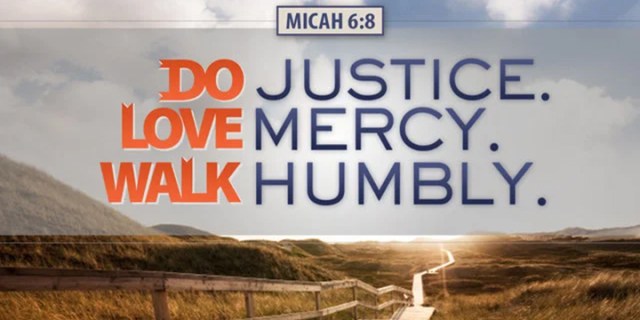
One of the greatest statements about what God requires is found in the Book of Micah, “And what does the LORD require of you but to do justly, to love mercy, and to walk humbly with your God?” – Micah 6:8. As Jesus began His Sermon on the Mount, He said, “Blessed are the poor in spirit, for theirs is the kingdom of heaven.” – Matthew 5:3. A free translation would be: “Blessed are those who realize their utter helplessness and who have put their whole trust in God.” Those are the individuals God will use, ones characterized by humility.

The word “humility” comes from the Latin word “humus,” which means “ground.” A humble person is one who is lowly and does not think himself or herself something he or she really is not. Humility is the golden virtue of the Christian life. It is the most fragile of all virtues, for once we think we have it, we have already lost it.

Humility displaces pride, the root of all sins. Having humility means that we do not get our feelings hurt. The humble person is like the ground, when stepped on, it does not complain. A humble person puts God first, others second, and self last. No task is too lowly for the humble person. In the kingdom of Christ, the way to the top is downstairs. Therefore, sink yourself into the highest place!

There is a very old fable that tells how the angels were impressed by the godly and beautiful life of an aged saint. Coming down from heaven to visit, the angel offered to give the man the gift of miracles. By the touch of his hand, he could heal the sick, restore sight to the blind, and bring the dead back to life. “Oh, no,” the saint responded, “the ability to heal belongs to God alone.”

The angel suggested, “Then let me give you the ability to bring people under conviction so that the unsaved will come to God.”

“No, that’s not for me either. That ability belongs only to God the Holy Spirit.”

“Then at least,” the angel offered, “you can let me make you the very person of virtue so people will be drawn to you by the virtue of your life.”

The aged man responded, “No, God forbid! Jesus Christ alone is our example. If people were drawn to me, they might not be drawn to Him.”

“Then what gift do you desire?”

The saint responded, “Only this: that I might have His grace, so that I might do good to all men without their knowing that I did it.” With that kind of attitude, we can accomplish a great deal for God’s glory as we serve Him through the church.

To Be Continued

pastor's desk footer

Unless otherwise noted, Scripture taken from the New King James Version®, NKJV © 1982 by Thomas Nelson.

Posted in Pastor's Desk | Tagged , , , , , , , , , , , , , , , , , , , , , , , , , , , , , , , , , , , , , , | Leave a comment

Peace In a World of War – 2

prophetic words header wp

Therefore, having been justified by faith, we have peace with God through our Lord Jesus Christ. – Romans 5:1

In these messages we shall discuss peace as prophesied and developed in the Word of God. We shall first present Him who is our peace and the Prince of Peace. Then we shall see that this Prince of Peace can give peace to everyone who trusts in His blood. We shall see that there can be peace only where He is, and where He is not there can be no peace; and finally we shall look to the grand, consummated, glorious peace on earth when He shall come to rule and reign in righteousness.

The Whole Burnt Offering – Continued

From last lesson: Do not try to walk until you have learned to worship, and do not try to work until your walk is clean. That is God’s order. God is more interested in our worship than in our service. He knows that true worship will result in service, but service without worship is vain and void. Christians, in their zeal they do not realize that we can do more by prayer and worship in one hour than in a year of effort in the energy of the flesh.

This divine order is further illustrated in the five offerings. The burnt offering comes first. In it an animal was slain by the priest and placed upon the altar in the court of the Tabernacle. The characteristic of this offering was that it was called the whole burnt offering. While part of the other offerings was given to the priest and the offerer (they that served at the altar were “partakers of the altar”), not so with this first one. Not a shred of it was given to the priest or anyone else. It was to be burnt whole upon the altar. Every part of it was to be consumed. It represents the Cross of Calvary, the place where our redemption roots and grounds itself. The Cross is the foundation of all our redemption. That is why the Altar of Burnt Offering stood at the very entrance to the Tabernacle of the congregation. As the Israelite entered the door he met first the Altar of Burnt Offering. Until he stopped there, he could never go beyond. There was no approach to the laver or the table of shewbread or the golden candlestick, much less the Holy of Holies, until the priest had first stopped at the altar. Here the whole animal was slain and consumed. Here the blood was shed which formed the basis of everything which followed. Here upon the death of the innocent substitute rested every blessing of salvation. No wonder, then, that Satan should try to eliminate the Altar of Burnt Offering, the Cross! No wonder that infidelity levels all its attacks upon the blood and the need of an innocent substitute for the sin of man! Once the blood and the Cross are removed, everything else becomes powerless and vain. The Cross stands first in the plan of salvation.

pw way of the cross

I must needs go home by the way of the Cross,
There’s no other way but this;
I shall ne’er get sight of the gates of light
If the way of the Cross I miss.

The altar blocked the way into the Tabernacle and to go through the door meant to go by the Cross. How significant the words of the Lord Jesus when He said, “I am the door.” – John 10:7. That door opened to the Cross. He said, “He who does not enter the sheepfold by the door . . . the same is a thief and a robber.” – John 10:1. To enter the Tabernacle any other way but by the door is to eliminate the altar and the Cross. No! There is no salvation apart from the Cross and the blood.

This first offering was the whole burnt offering. Man added nothing to it, and man had no part in it whatsoever. What a picture of the Savior’s work! He must bear the sin of the world alone. No one could help Him. Even in the last dread hour God hid His face as the Lord Jesus cried, “My God, my God, why hast thou forsaken me?” (Matthew 27:46; Mark 15:34; see also Psalm 22:1). In the work of salvation man has no part except to receive what Christ alone provided. See Him hanging there, forsaken by God and man, bearing the sin of a lost world in His own body on the tree, experiencing alone the infinite wrath of God upon sin. Well did Isaiah the prophet see this when he said, “I have trodden the winepress alone, and from the peoples no one was with Me.” – Isaiah 63:3, and Peter, when he said, “Who Himself bore our sins in His own body on the tree.” – 1 Peter 2:24.

Alone my Saviour bled and died
On Calvary’s rough and cruel tree,
That I, forever justified,
At peace with God might ever be.

No toil of mine could ought avail,
No help of mine would He receive,
Complete the offering He gave,
And all I do is just believe.

Christ is the whole burnt offering, dying on the Altar of the Whole Burnt Offering, to provide a ransom for sinners.

To Be Continued

prophetic words footer 2

Adapted and modified excerpts from M. R. De Haan, The Second Coming of Jesus.
Unless otherwise noted, Scripture taken from the New King James Version®, NKJV © 1982 by Thomas Nelson.
Used by permission. All rights reserved.
Posted in Prophetic Words | Tagged , , , , , , , , , , , , , , , , , , , , , , , , , , , , , , , , , , , , , , , , , , , , , , | Leave a comment

Let Yourself Alone

classic poetry header
*Pastor’s Note: A.B. Simpson was a very well respected Canadian preacher, theologian and author who lived from December 15, 1843 to October 29, 1919. My prayer is that you will be blessed and inspired by his poetry as much as I am.


LET YOURSELF ALONE

Vain and fruitless is the struggle
Self to sanctify;
God alone can cleanse and keep you,
Wherefore should you try?
Oh, the needless cares and conflicts
You had never known,
If you’d learned the simple lesson,—
Let yourself alone.

Let your eyes keep looking upward;
Cease to look within;
All your introspection cannot
Cleanse a single sin.
You will find your best self effort
Vain, and worse than vain,
As the touch of soiled fingers
Only leaves a stain.

Leave your rights and reputation
In the Master’s hand.
What though men misunderstand you,
Jesus understands;
He can shield and vindicate you,
Right your every wrong,
Turn the hate of men and devils
Into joy and song.

It is life you need, not labor—
Life that springs from Him;
If you’d have your cup run over,
Fill it to the brim.
All the springs of power and blessing
Flow from yonder throne;
If you’d have them fill and flood you,
Let yourself alone.

classic poetry footer

From Songs of the Spirit: Poetry by A. B. Simpson. Public Domain
Posted in Classic Poetry | Tagged , , , , , , , , , , , , , , , , , , , , , , , , , , , , , , , , , , | Leave a comment

The Example Set Us By The Holy Fathers – 2

devotionals header

Continued From Last Week

THEY [the followers of Christ] renounced all riches, dignities, honors, friends, and associates. They desired nothing of the world. They scarcely allowed themselves the necessities of life, and the service of the body, even when necessary, was irksome to them. They were poor in earthly things but rich in grace and virtue. Outwardly destitute, inwardly they were full of grace and divine consolation. Strangers to the world, they were close and intimate friends of God. To themselves they seemed as nothing, and they were despised by the world, but in the eyes of God they were precious and beloved. They lived in true humility and simple obedience; they walked in charity and patience, making progress daily on the pathway of spiritual life and obtaining great favor with God.

They were given as an example for all religious, and their power to stimulate us to perfection ought to be greater than that of the lukewarm to tempt us to laxity.

How great was the fervor of all religious in the beginning of their holy institution! How great their devotion in prayer and their rivalry for virtue! What splendid discipline flourished among them! What great reverence and obedience in all things under the rule of a superior! The footsteps they left behind still bear witness that they indeed were holy and perfect men who fought bravely and conquered the world.

Today, he who is not a transgressor and who can bear patiently the duties which he has taken upon himself is considered great. How lukewarm and negligent we are! We lose our original fervor very quickly and we even become weary of life from laziness! Do not you, who have seen so many examples of the devout, fall asleep in the pursuit of virtue!


The Imitation of Christ, by Thomas à Kempis, is a Christian devotional book first composed in Medieval Latin as De Imitatione Christi (c. 1418–1427). The devotional text is divided into four books of detailed spiritual instructions. The devotional approach of The Imitation of Christ emphasizes the interior life and withdrawal from the mundanities of the world, as opposed to the active imitation of Christ practiced by other friars. The Imitation is perhaps the most widely read Christian devotional work after the Bible, and is regarded as a devotional and religious classic. The book was written anonymously in Latin in the Netherlands c. 1418–1427. Its popularity was immediate, and after the first printed edition in 1471-72, it was printed in 745 editions before 1650. Apart from the Bible, no book had been translated into more languages than the Imitation of Christ at the time.

devotionals footer

Thomas à Kempis, The Imitation of Christ. Public Domain
Posted in Classic Devotionals | Tagged , , , , , , , , , , , , , , , , , , , , , , , , , , , , , , , , , | Leave a comment

Gideon, An Unlikely Hero – 15

great sermons header

gs - c.h. mackintosh

Charles Henry Mackintosh (October 1820 – November 2, 1896) was a nineteenth-century Christian preacher, dispensationalist, writer of Bible commentaries, magazine editor and member of the Plymouth Brethren. In 1843, Mackintosh wrote his first tract entitled Peace with God. When he was 24, he opened a private school where he developed a special method of teaching classical languages. Mackintosh went around preaching the gospel to the poor during school holidays. He wrote to John Nelson Darby on August 31, 1853 that the Lord had “called me into larger service than ever,” and he soon concluded that he must give himself entirely to preaching, writing, and public speaking.

Gideon, An Unlikely Hero Part 15

From last lesson: Like the blast of Gideon’s trumpet, so the clear testimony which has widely gone forth of late years has attracted many; and while we quite feel that there is real ground for thankfulness in this, we also feel that there is ground for very serious reflection indeed.

Truth is a most precious thing, if it be truthfully found and truthfully held: but let us remember that in exact proportion to the preciousness of the truth of God so is the moral danger of moving forward without a self-judged heart and an exercised conscience. What we really need is faith—unfeigned, earnest, simple faith, which connects the soul, in living power, with God, and enables us to overcome all the difficulties and discouragements of the way. Of this faith there can be no imitation. We must either possess it in reality or not at all. A sham faith will speedily come to the ground. The man who attempts to walk by faith, if he doesn’t have it, must speedily stumble and fall. We cannot face the hosts of Midian unless we have full confidence in the living God. “Whosoever is fearful and afraid, let him return.” Thus it must ever be. None can go to battle save those who are braced up by a faith that grasps the unseen realities of eternity, and endures as seeing Him who is invisible. May this faith be ours, in larger measure, beloved reader.

It is full of instruction for the heart to notice the effect of the first test upon the host of Gideon. It thinned his ranks amazingly. “There returned of the people twenty and two thousand, and there remained ten thousand.” This was a serious reduction. But it is far better to have ten thousand that can trust God than ten thousand times ten thousand who cannot. Of what use are numbers, if they be not energized by a living faith? None whatever. It is comparatively easy to flock around a standard raised by a vigorous hand; but it is a totally different thing to stand, in personal energy, in the actual battle. Nothing but genuine faith can do this; and hence when the searching question is put, “Who can trust God?” the showy ranks of profession are speedily thinned.

But there was yet another test for Gideon’s companions. “And the Lord said unto Gideon, The people are yet too many; bring them down unto the water, and I will try them for thee there: and it shall be, that of whom I say unto thee, This shall go with thee, the same shall go with thee; and of whomsoever I say unto thee, This shall not go with thee, the same shall not go. So he brought down the people unto the water: and the Lord said unto Gideon, Every one that lappeth of the water with his tongue, as a dog lappeth, him shalt thou set by himself; likewise every one that boweth down upon his knees to drink. And the number of them that lapped, putting their hand to their mouth, were three hundred men: but all the rest of the people bowed down upon their knees to drink water. And the Lord said unto Gideon, By the three hundred men that lapped will I save you, and deliver the Midianites into thine hand: and let all the other people go every man unto his place.” – Judges 7:4–7.

Here then we have another great moral quality which must characterize those who will act for God and His people, in an evil day. They must not only have confidence in God, but they must also be prepared to surrender self. This is a universal law in the service of Christ. If we want to swim in God’s current, we must sink self; and we can only sink self in proportion as we trust Christ. It is not, need we say, a question of salvation; it is a question of service. It is not a question of being a child of God, but of being a proper servant of Christ. The thirty-one thousand seven hundred that were dismissed from Gideon’s army, were just as much Israelites as the three hundred that remained; but they were not fitted for the moment of conflict; they were not the right men for the crisis. And why? They could not trust God and surrender self. They were full of fear when they ought to have been full of faith. They made refreshment and comfort their object instead of conflict.

Here, reader, lay the true secret of their moral unfitness. God cannot trust those who do not trust Him and sink self. This is pre-eminently solemn and practical. We live in a day of easy profession and self-indulgence. Knowledge can, now-a-days, be picked up at very small cost. Scraps of truth can be gathered, second hand, in all directions. Truth which cost some of God’s dear servants years of deep soul-ploughing and heart-searching exercise, is now in free circulation and can be intellectually seized and flippantly professed, by many who know not what soul-ploughing or heart-exercise means.

But let us never forget—yes, let us constantly remember—that the life of faith is a reality; service is a reality; testimony for Christ, a reality. And further let us bear in mind that if we want to stand for Christ in an evil day—if we would be men for the crisis, genuine servants, true witnesses—then verily we must learn the true meaning of those two qualities, namely, confidence in God, and self-surrender.

To Be Continued

gs gideon unlikely hero

Minor adaptation of excerpts from C. H Mackintosh, Gideon and His Companions. Public Domain.
Unless otherwise noted, Scripture taken from The Holy Bible: King James Version (KJV) Public Domain.
Posted in Great Sermons From The Past | Tagged , , , , , , , , , , , , , , , , , , , , , , , , , , , , , , , , , , , | Leave a comment

Curing Me-First-Ism

thought of day header

For Saturday February 4, 2023

1 Timothy 3:6
[An elder must not be] a novice, lest being puffed up with pride he fall
into the same condemnation as the devil.

The late theologian Francis Schaeffer wrote that when we violate one of the Ten Commandments, we actually violate two. Violating any other commandment means first violating the tenth: “You shall not covet.” To want another god, another day to work, to fail to honor our parents, to steal from another person … all are expressions of covetousness—the desire to take for ourselves.

Pride is likely another type of “root” sin, since it appears from Scripture that it was the first sin ever committed. Before the creation of man, when Satan was the “son of the morning” (Isaiah 14:12), he rose up in pride against God and declared he would “be like the Most High” and “exalt [his] throne above the stars of God” (Isaiah 14:13–14). Pride is the motivation that tempts us to put ourselves at the center of the universe, to make ourselves more important than anyone else. Pride leads to conflict and condemnation with us, just as it did with Satan. When you encounter conflict in your path, check first to see if pride is involved.

Repenting of pride—“me-first-ism”—releases us to heal conflicts by becoming servants to others.

It is . . . pride that feedeth at the root of all the rest of our sins.
RICHARD BAXTER

thought of the day footer 6

David Jeremiah, Turning Points with God: 365 Daily Devotions (Tyndale, 2014)
Unless otherwise noted, Scripture taken from the New King James Version®, NKJV © 1982 by Thomas Nelson.
Used by permission. All rights reserved.
Posted in Daily Devotional | Tagged , , , , , , , , , , , , , , , , , , , , , , , , , , , , , , , , , , , , , , , , , , | Leave a comment

Life In Focus 2/04/2023

life in focus header

Determining God’s Will

THE example of Gideon is frequently cited as a model for godly decision-making. Before acting, Gideon carefully considered whether the Lord wanted him to rally an army and attack the Midianites. Twice he set out a fleece (a clump of wool) to make sure of God’s intentions (Judges 6:36–40). On this basis, some have argued that before Christians make major decisions with long-range consequences, they should “put out a fleece before the Lord,” seeking some tangible sign that indicates His will with certainty.

Is that an appropriate way to know God’s will? In considering the question, it is important to note that this is the only occasion in the Bible when God revealed His will through a fleece. It is also worth noting Gideon’s extreme hesitation, doubt, and fear. The Lord had already told him what to do through the Angel of the Lord. In fact, the Angel had already given Gideon a confirming sign (Judges 6:11–22). In light of these facts, Gideon’s use of the fleece would appear to demonstrate a lack of faith more than any zeal to be certain of God’s will. Fortunately, God was patient with him and granted his request for a confirming sign. But it seems that using a fleece to determine God’s will was the exception rather than the rule, and thus does not serve as the best pattern for how we can depend on God for guidance.

Is there a more reliable way? Yes, God has clearly and objectively told us what He wants throughout the Bible. For example, the Ten Commandments give straightforward instructions to guide our behavior in numerous areas. Likewise, Thessalonians says plainly, “This is the will of God” (1 Thessalonians 4:3) in regard to sexuality. Thus when it comes to making choices in life, God calls us to clear thinking, thinking based on our relationship with Him and our allegiance to His values, which are clearly spelled out in Scripture.

God has made us to be thinking, discerning, analytical persons who assume responsibility for working our way through life in accordance with His general plans and purposes. He challenges us to learn all that we can about any situation, relationship, responsibility, or opportunity that we have, weigh it in light of His precepts and principles, and only then to act. And as we act, we can take comfort from the fact that He is at work within us, “both to will and to do for His good pleasure” (Philippians 2:13).

life in focus footer

Courtesy of Nelson’s New Illustrated Bible Commentary
Unless otherwise noted, Scripture taken from the New King James Version®, NKJV © 1982 by Thomas Nelson.
Used by permission. All rights reserved.
Posted in Life In Focus | Tagged , , , , , , , , , , , , , , , , , , , , , , , , , , , , , , , , , , , , | Leave a comment

Anecdotal Story 2/04/2023

anecdotal stories

Better Late Than . . .

That night the king could not sleep; so he ordered the book of the chronicles, the record of his reign, to be brought in and read to him. It was found recorded there that Mordecai had exposed Bigthana and Teresh, two of the king’s officers who guarded the doorway, who had conspired to assassinate King Xerxes.

“What honor and recognition has Mordecai received for this?” the king asked. “Nothing has been done for him,” his attendants answered. – Esther 6:1-3.

When Haman entered, the king asked him, “What should be done for the man the king delights to honor?” Now Haman thought to himself, “Who is there that the king would rather honor than me?” – Esther 6:6.

“Go at once,” the king commanded Haman. “Get the robe and the horse and do just as you have suggested for Mordecai the Jew, who sits at the king’s gate. Do not neglect anything you have recommended.” – Esther 6:10.

These have come so that the proven genuineness of your faith—of greater worth than gold, which perishes even though refined by fire—may result in praise, glory and honor when Jesus Christ is revealed. – 1 Peter 1:7.

Captain Joseph Rochefort and his merry musicians performed prodigies of excellence in breaking the Japanese codes during World War II. They provided the Navy with their greatest coup—the information that led to the incredible victory at Midway. Nominated for the Distinguished Service Medal by Fleet Admiral Chester Nimitz, he never received it. The victim of military bickering, he was transferred in 1942 and spent the war in Tiburon, California. He died in 1976, embittered by his mistreatment. In 1983, as an apology, the Navy honored Rochefort with a plaque at the old Pearl Harbor offices, a tardy acknowledgment of the man who led a corps of code breakers to give the U. S. Navy the advantage it needed to blunt Japan’s surging conquests in 1942.

God won’t overlook any servant who deserves special rewards. No rival exists to challenge the bequests as he chooses to grant them. God rewards his servants daily by making them coheirs with Christ of an immense, eternal inheritance. Since it is presently ours, we borrow against it for the daily grace needed to overcome the world. Aspiring to an exalted place we don’t yet have doesn’t daunt us, for we presently possess an exalted position we don’t deserve. It is all our birthright through Jesus Christ. And anyone can share in it who accepts him as Savior and Lord. Not one of us in the world is enriched with all of God’s grace; it just seems that way!

anecdotal story footer 3

Courtesy of Speaker’s Sourcebook of New Illustrations by Virgil Hurley © 1995 by Word, Incorporated.
Unless otherwise noted, Scripture taken from the Holy Bible, New International Version®, NIV © 2011 by Biblica, Inc.®
Used by permission. All rights reserved.
Posted in Anecdotal Stories | Tagged , , , , , , , , , , , , , , , , , , , , , , , , , , , , | Leave a comment

Saturday Prayer & Praise 2/04/2023

prayer and praise header 3
David Clarkson: Piercing Heaven – Puritan’s Prayers

We cry to you, God, for renewing grace. We lie at your footstool and cry, “Help, Lord, or else I perish!”

Create in me a new heart, and renew a right spirit within me.

Renew me in the spirit of my mind, and renew me in my inner soul.

Take away this old mind that is so blind, so vain, so carnal.

Take away this old will that is so obstinate, so perverse, so rebellious.

Take away this old conscience that is so partial, so seared, so senseless.

Take away this old heart that will never delight in, comply with, or submit to you.

Let old things pass away, let all things become new. You who brought this world out of nothing with a word, can with a word work in me this new creation.

Do not let me perish. Say the word, and it will be done. Just say the word, and this soul—now a dark, woeful chaos and a lump of corruption and confusion—will become a new creature.

Lord, give me this new heart, put this new spirit into me. You have the key of David. You close, and no one opens. You open, and no one can shut. Lord, open this heart that has been too long closed against you. Break down these strongholds that keep you from me.

Cast out sin and cast out the world that kept you out of possession for so long. Bind the strong man and cast him out.

Other lords have had dominion over me; they have made me miserable by keeping my Lord, my happiness, from me. Cast out these intruders, take possession of me, and be mine forever.

You call for my heart, Lord; it is yours. Though I have dealt treacherously with you, and given my heart to other things, it is yours. It cost you dearly. So enter, take possession of it.

You knock at the door to this wretched heart. Why stay so long outside? Come in and bless me with your presence. Break it open with almighty power, and let it no longer shut you out.

Amen.

puritan prayers footer

Posted in Prayer and Praise | Tagged , , , , , , , , , , , , , , , , , , , , , , , , , , , , , , , , , , , , , , | Leave a comment